
A solar rooflight is an ordinary powered rooflight with its supply problem solved locally. A small photovoltaic panel on the outside of the frame charges a battery inside it, and the battery drives the same 24V actuator that a mains unit would use. There is no cable to the ceiling, no transformer to house, no first-fix coordination and no electrician needed for the unit itself. That is a genuinely large advantage in a finished house, and it is why these products exist. The trade is that everything the unit does has to fit within an energy budget set by a panel roughly the size of a paperback, in England, facing whichever way your roof happens to face. This page is about what that budget will and will not pay for.
What is actually inside a solar unit
Four components, all factory-fitted into the frame.
- A photovoltaic panel, typically 1 to 3 watts, laminated into the top cover or a slim strip along the head of the unit.
- A rechargeable battery, usually a lithium or nickel-based pack of modest capacity, sited inside the frame profile.
- A charge and control board that manages charging, holds the radio pairing and drives the motor.
- The actuator itself, mechanically identical to the mains version in most ranges, chosen for low current draw.
The whole assembly is sealed by the manufacturer and arrives as one item. Nothing about it is site-assembled, which is a large part of why installation is simple. Our page on how electric rooflight actuators work covers the drive side, and it does not change because the electricity comes from the roof.
Sizing the panel against the actuator
A 2 watt panel in decent English daylight might average a few watt-hours a day across the year. An actuator drawing 1A at 24V for forty seconds uses a fraction of a watt-hour per cycle.
Written that way, the arithmetic looks comfortable, and for the core function it is. A solar rooflight has ample energy for several open and close cycles a day, all year, in most positions. Where the budget gets tight is everything else: a heated rain sensor drawing continuously, a radio receiver listening around the clock, a blind motor sharing the same pack. Manufacturers manage this by sleeping the receiver between commands and by only energising a sensor heater when the sash is open, and it works, but it explains why solar units sometimes behave differently from their mains equivalents in small ways.
The battery, and what it is asked to do
The battery is not there to store months of energy. It is a buffer, sized to carry the unit through a run of dull days and through the nights.
Typical capacity gives something in the order of a few hundred operations from full without any charging at all. In practice that means a fortnight of December gloom will not stop the unit working, but a rooflight left in permanent deep shade with no charging at all will eventually go flat. The failure is gradual and visible: cycles become slower, the sash stops short, and then nothing happens. It does not fail suddenly on a bright June morning.
Charge behaviour through an English winter
This is the question worth asking honestly, and the answer is better than people fear.
Winter daylight in Oxfordshire is weak but it is not absent, and photovoltaic cells produce usefully under overcast skies, just at a lower rate. A December day still delivers charge. Meanwhile winter is the season a rooflight is opened least: a few short vent cycles rather than being held open all afternoon. Demand falls at roughly the same time supply does. Where solar units struggle is not the season but the position, and that is a different problem.
Orientation, pitch and shading
Position beats season every time. Three factors decide whether a given roof can support a solar unit.
Orientation. A south-facing slope is ideal. East and west are perfectly serviceable. A north-facing slope receives only diffuse light and is the one to think hard about, particularly at a shallow pitch.
Pitch. The panel sits in the plane of the roof, so the roof pitch is the panel pitch. A steep south slope in winter is excellent because it faces a low sun squarely. A flat roof unit’s panel points at the sky, which is good in summer and poor in December.
Shading. The killer. A chimney stack, a dormer cheek, a neighbouring gable or a mature tree that puts the head of the unit in shadow for most of the day will starve it. Shade for part of the day is fine. Shade all day is a reason to run a cable instead.
Rooms where solar is the obvious answer
The clearest case is a finished house where the ceiling is plastered, decorated and not coming down.

A first-floor bathroom in an existing house. A landing rooflight above a stairwell where the void is boxed in and inaccessible. A converted loft finished five years ago where somebody now wants ventilation that actually gets used. A listed or period property where chasing cables through original fabric is unwelcome. A garden room or outbuilding with no consumer unit of its own. In all of these the alternative is not “a cheap mains unit” but “a mains unit plus surface trunking or a section of opened ceiling”, and against that comparison the solar premium usually looks small.
Where solar is the wrong choice
Be equally clear about the other direction. If the ceiling is open right now and a cable can be pulled in twenty minutes, a mains unit is the better engineering answer. It has no battery to age, no charging to worry about, no seasonal behaviour and a controller with unlimited power for sensors and blinds.
Solar is also weaker where a unit must operate on demand at any moment regardless of conditions, or where it forms part of an escape or smoke ventilation arrangement, which brings its own supply and backup requirements that are not a homeowner’s decision to make. And on a north slope under a tree, as above, it is simply the wrong product.
Comparing solar against a mains run
| Solar unit | Mains unit | |
|---|---|---|
| Cable to ceiling | None | Required, first fix |
| Electrician needed | Not for the unit | Yes, for supply and certification |
| Unit cost | Higher | Lower |
| Installation cost | Lower in a finished house | Lower during a build |
| Consumable parts | Battery, in time | None |
| Behaviour in a power cut | Unaffected | Stops until supply returns |
| Best moment to choose | House already finished | Ceiling still open |
The row people overlook is the power cut. A solar unit carries its own supply, so it closes on its rain sensor and answers its remote during an outage. That is a real and often unmentioned advantage, and it sits alongside what is said on backup power and what happens in a cut.
Solar blinds, and whether they share the battery
Solar blinds are a separate product from solar openers, and this trips people up regularly.
A solar blind has its own small panel and its own battery, mounted in the blind’s own head rail or top bar, and it is entirely independent of the sash mechanism. That is convenient because it can be added to a manual rooflight, to a mains rooflight, or to a solar one without any relationship between them. It also means a solar blind on a unit with heavy blackout fabric is working a motor against friction in side channels all day, and its energy budget is tighter than the opener’s. Blinds inside the aperture are covered properly on our page about electric blinds fitted inside the rooflight.
Charging when light is genuinely poor
Most manufacturers provide a route to charge the pack directly, either a socket on the control unit or a plug-in charger that connects temporarily inside the room.

This is a sensible safety net rather than a routine arrangement. If a unit is going flat every winter, the answer is not an annual charging ritual, it is that the unit is in the wrong position for solar. But it is genuinely useful in the first weeks after installation, when a pack may arrive part-charged in November, and it means a shaded unit can be recovered without a scaffold.
Battery replacement and the access it needs
The pack is a consumable. Expect a service life measured in years rather than decades, and expect it to be replaceable as a manufacturer’s part.
The practical question is not cost but access. On a pitched roof window the battery is usually reached from inside the room by removing a cover on the sash, which is a fifteen-minute job on a unit within reach and a scaffold job on one that is not. On a flat-roof unit it may be reached from above. This is worth asking about before ordering, because a solar unit specified precisely because it sits somewhere awkward is also a unit whose battery sits somewhere awkward. Where a solar rooflight is going into a genuinely unreachable position, that is a point in favour of a mains unit even if a cable is a nuisance.
Radio, pairing and grouping solar units
Solar units are controlled by radio, because a cable to a wall switch would defeat the point. Every unit is supplied with a remote and paired to it at commissioning.
Several units can be grouped so that one button closes all of them, and that is the arrangement to ask for where a room has three rooflights. Pairing is a procedure with a specific button sequence on each unit, and it needs doing while the unit is still reachable, which in practice means at installation. A radio keypad fixed to the wall by the door gives the household something that behaves like a light switch without any cable at all, and that is usually the right specification rather than relying on a handheld remote alone.
Retrofitting into a finished ceiling
Replacing an existing manual rooflight with a solar one is the most common version of this job, and it is a clean piece of work.
The old unit comes out, the aperture is checked and adjusted for the new frame, the new unit goes in, the flashings are formed and the covering is dressed back. Inside, the plasterboard reveal is made good where the frame position differs. There is no chasing, no cable, no electrician and no second visit from another trade. The roof is not left open overnight at any point. Compared with the same job on a mains unit in a finished house, it removes an entire workstream.
Questions we ask at survey
Five things decide whether solar is right for a particular roof, and we settle them on site rather than over the phone.
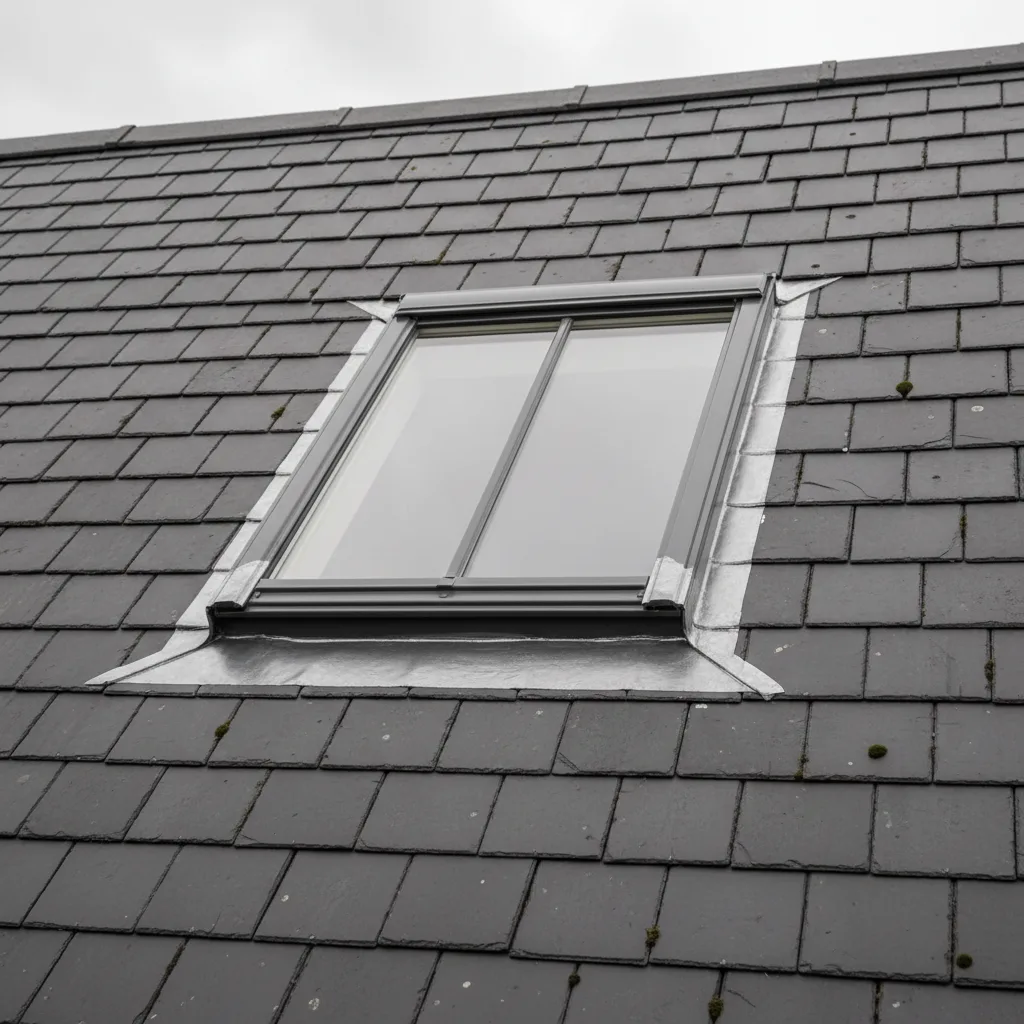
Which way the slope faces and at what pitch. What overshadows it at nine, at midday and at four. Whether the ceiling is open, coming down, or staying. Whether the unit will be reachable for a battery in eight years. And what the unit is actually for, because a vent used twice a day has a different budget from one held open all summer. If the answers point at a mains run, we will say so, and our page on wiring an electric rooflight at first fix sets out what that involves.
What we install, and what we do not touch
We install and replace rooflights, including solar-powered units from VELUX, Fakro, Keylite and Roto. The aperture, the upstand, the unit, the flashings, the weathering and the internal reveal are our work and carry our ten-year workmanship guarantee. Pairing the remote and cycling the unit at handover is part of that.
Where a job involves any connection to the fixed wiring of the house, that work is done and certified by a qualified electrician. A solar unit is attractive precisely because it usually removes that requirement, but we will not pretend otherwise on a job where it applies. Fifteen years in the trade, working across Oxford and 25 miles by road. Call 01865 704245 or email info@heritageskylightsoxford.co.uk for a range by email, then a fixed price after a survey.
Four steps, no surprises
Survey
We look at the roof, the covering and the slope before we say anything about price.
Specification
The right unit and glazing for that roof and that orientation, in plain terms.
Fixed quote
Written, itemised and firm. The number does not move once work starts.
Install
Opening formed, unit set and weathered, covering made good. Notification is ours.
Helpful reading on this
Costs, comparisons and the questions we are asked most.
Tell us about your roof
We start with the building, the covering and the slope. Then we tell you what will suit it, and what it will cost, as a fixed written number.
- Surveyed before it is priced
- 10-year workmanship guarantee
- Building Control notification handled
- New installations and replacements