
A blind made for a rooflight is not a curtain hung under one. It fits inside the frame, running in side channels machined or extruded into the unit itself, so the fabric sits close to the glass and cannot hang away from it at an angle. That distinction decides everything: how well it blocks light, whether it controls heat, whether it fouls the opening mechanism, and whether it can be added later at all. Powered versions add a motor in the head rail or the top bar, a battery or a supply, and a control that ought to be the same one that drives the sash. What follows is how they are built, where they sit in the unit, what they will and will not do about heat, and the decisions that have to be taken before the rooflight is ordered.
Where the blind physically sits
Three positions, and they are not interchangeable.
Inside the frame, on the room side of the glass. The standard arrangement. The fabric runs in channels that are part of the sash or frame profile, the motor and roller are in a head rail that clips into the top of the unit, and the whole assembly moves with the sash when it opens. Neat, close to the glass, invisible from outside.
Between the panes. A factory-sealed blind inside the glazing cavity. Never needs cleaning, never fouls anything, and cannot be replaced without replacing the glass. Uncommon on rooflights.
On the outside of the glass. An external awning, mesh or shutter, running on the outer face. Ugly to some eyes, and by far the most effective thing available for heat.
Blackout, pleated, venetian and awning
The four types answer four different briefs, and picking by appearance rather than by function is the usual mistake.
| Type | Light control | Heat control | Typical room |
|---|---|---|---|
| Blackout | Near total, with side channels | Modest, some reflective backing | Bedroom, nursery, media room |
| Pleated | Diffuses, does not block | Slight | Landing, study, bathroom |
| Venetian | Adjustable, directional | Slight | Kitchen, home office |
| External awning | Reduces glare, keeps the view | Substantial | Any room that overheats |
The row that surprises people is the last one. If the actual complaint is a room that becomes unusable on a July afternoon, an internal blackout blind is the wrong tool and an external awning is the right one, for reasons of physics rather than fashion.
Why outside the glass beats inside it for heat
Solar gain arrives as short-wave radiation, passes through the glass and is absorbed by whatever it lands on. What it lands on then re-radiates that energy as long-wave heat, and glass is far less transparent to long-wave than to short-wave.
An internal blind is on the wrong side of that. The energy has already entered the room before the fabric absorbs it, the fabric warms up, and the heat it releases stays inside. A well-specified blackout blind with a reflective backing sends some of it back out again, which helps, but it cannot undo the basic arrangement. An external blind or awning intercepts the radiation before it crosses the glass at all, so the heat is rejected outside. The difference in a south-facing loft room is not marginal.
Side channels and light leak
A blackout blind that is not blackout is the most common complaint about rooflight blinds, and the cause is almost always the edges.
Fabric alone blocks light. Fabric in a rooflight has three other paths around it: the two sides, the gap at the bottom bar, and the gap behind the head rail. A proper rooflight blind runs its fabric in a channel on each side that traps the edge, so no light passes at the sides. The bottom bar seats into a recess at the cill. Blinds sold as a generic roller cut to size have none of that and will produce a bright outline around the whole unit. In a nursery, that outline is the difference between a child sleeping and not.
Powering the blind: three options
The motor sits in the head rail or top bar, it is small, and it draws very little. Three ways to feed it.
- Mains, through the unit’s power supply. Cleanest where a cable already exists. No batteries, unlimited cycles, and the blind can share a controller with the sash.
- Solar. A small panel on the head rail or on the outside of the unit charges an integral pack. No cable at all, which is why it dominates retrofit work. Covered further on our page about solar powered rooflights without a mains run.
- Battery only. A rechargeable pack with no charging source, topped up by plugging in periodically. Cheap, and a nuisance on any unit that is not easily reached.
A blind motor works against friction in the side channels every time it runs, so its energy demand per cycle is not trivial, and a blind operated several times a day has a different budget from one that goes down at night and up in the morning.
Fitting the blind with the unit rather than after
Fitting a blind at the same time as the rooflight is straightforward, quick and produces the best result. Fitting one later is possible on most modern units and is dealt with on our page about adding electric blinds later.

The advantages of doing it together are practical. The unit is already accessible, so no second access arrangement is needed. Pairing to a remote or keypad happens once, with everything in front of you. If the blind is mains powered, the cable is planned into the same first-fix route as the actuator. And the reveal can be formed knowing the head rail is there, which matters more than it sounds.
Reveal and lining depth around the aperture
This is the detail that ruins otherwise good installations, and it is decided by a plasterer weeks before anybody thinks about a blind.
The plasterboard reveal around a rooflight is usually splayed, wider at the room than at the frame, to throw light into the room. If that splay starts too close to the frame at the head, it will foul the head rail of a blind, or leave the blind sitting proud in a way that reads as an afterthought. The rule is simple: form the reveal so the frame’s internal face is left clear by the depth the blind assembly needs, which the manufacturer states, and do not let a splay encroach on it. Tell the plasterer a blind is coming even if it is coming in three years.
Blinds on flat-roof rooflights
Flat-roof units change the geometry completely, and blinds designed for pitched roof windows do not simply transfer.
On a flat unit the glass is horizontal or nearly so, and there is nothing but the fabric’s own tension holding it flat, because gravity is pulling it straight down rather than along the plane of the glass. That is why flat-roof blinds use a tensioned cable or track system, or a honeycomb pleated fabric that holds its own shape, and why a simple roller will sag. Many flat units also sit on an upstand, which means the blind can be fitted at the glass or at ceiling level, and those two positions look and behave very differently. Decide which before ordering.
Intermediate positions and memory stops
Powered blinds do more than up and down, and most people never find out.
Nearly all of them will stop anywhere on the travel while a button is held. Better controllers store a favourite position, so one press sends the blind to a specific point that suits the room, typically covering the top two-thirds of a rooflight in a study to kill glare on a screen while leaving the view. Setting that position takes about a minute at commissioning and is much harder to be bothered with later. Ask for it to be set on the day.
Running the blind and the sash from one control
Where both the sash and the blind are powered, they should be on the same control system, on different channels.

Same system, so one wall keypad and one remote operate both and a household does not accumulate handsets. Different channels, so opening the rooflight does not raise the blind, because those two actions are wanted independently and often in combination. The interaction to check at commissioning is mechanical rather than electrical: on some units a blind at full extension can interfere with the sash reaching full travel, and it is worth cycling both together to prove they coexist. Rain sensor logic closes the sash and does not touch the blind, as set out on our page about rain sensors and what they actually do.
Fabric, cleaning and what shortens a blind’s life
Rooflight blind fabric lives in strong daylight and, in a bathroom or kitchen, in humid air. Both take a toll.
Cleaning is a vacuum with a brush attachment for dust, and a damp cloth on the bottom bar. Blackout fabrics with a metallised backing should not be scrubbed, because the coating is what gives them their reflectivity. The two things that genuinely shorten a blind’s life are grease, in a kitchen where a rooflight sits over a hob without extraction, and condensation running off cold glass onto the top of a raised blind. The second is a ventilation problem showing up as a blind problem, and treating the blind is treating the symptom.
Sizes, tolerances and non-standard apertures
Branded blinds are made to match branded rooflights by size code, and the fit is exact because both come off the same drawing.
That is the strongest practical argument for buying the blind from the maker of the unit. A blind ordered against a size code drops into its channels and works. A blind ordered by measuring an aperture with a tape has to accommodate tolerance somewhere, and on a rooflight that tolerance shows as a light gap. Where a rooflight is a bespoke or a non-standard size, powered blinds are still available but they are a made-to-measure item with a longer lead time, and the measurements have to come off the finished unit rather than off a drawing. Plan the lead time in.
Where a blind is the wrong answer
Three cases where we will tell you not to bother.
A north-facing rooflight over a landing, where there is no glare, no overheating and nobody sleeping. A rooflight so high that the blind can only be operated by remote and cleaned by scaffold, where the honest answer may be a solar control glass specification instead. And a room whose real problem is summer overheating, where an internal blind will be bought, fitted, and then blamed for not doing a job it was never capable of. In that third case the money is better spent on external shading or on the glass specification.
What has to be decided before the rooflight is ordered
Blinds feel like an afterthought and are not. Four things are locked at order stage or shortly after.
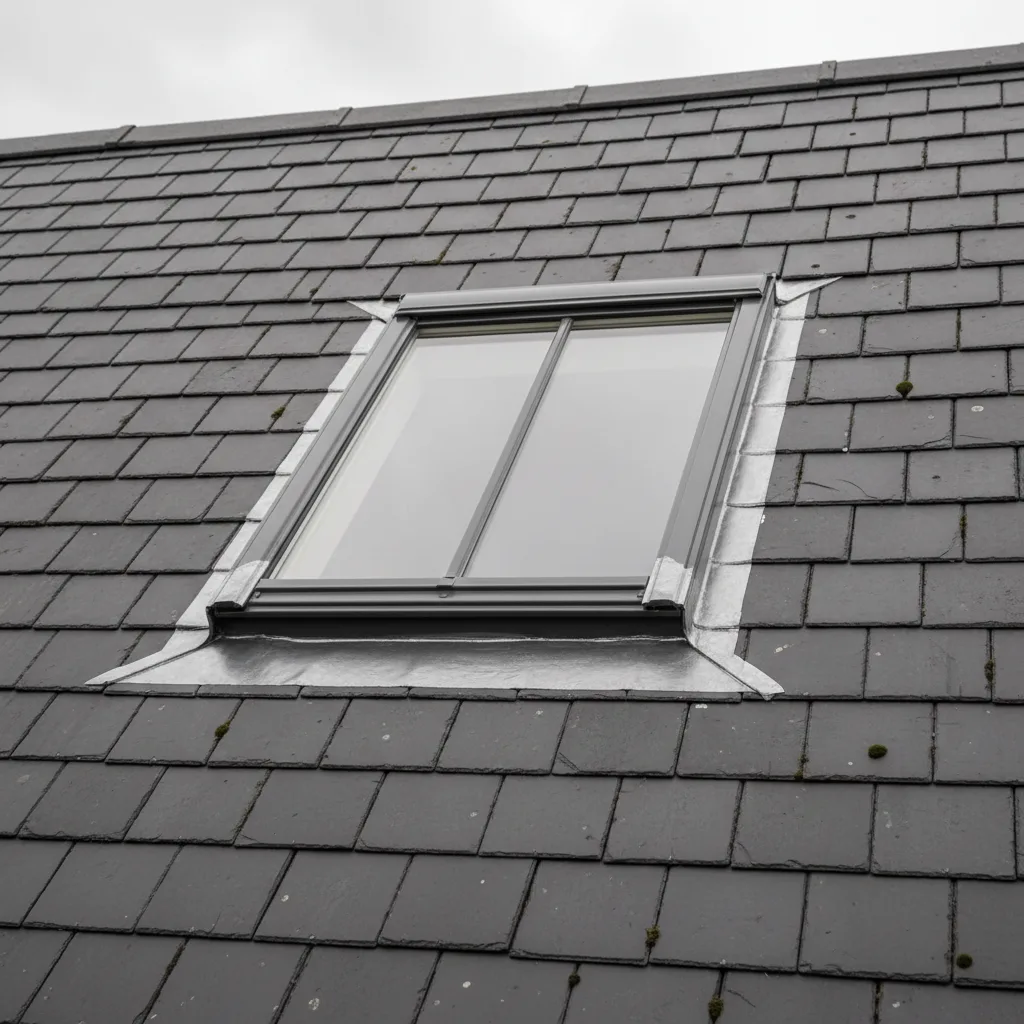
Whether the unit is a range that has blinds available at all, because not every rooflight does. Whether the blind will be mains or solar, which determines whether a cable is needed in the first-fix route. What the reveal depth must leave clear at the head. And whether the blind is being fitted now or later, because a unit chosen with later fitting in mind should be one whose blind channels are already there. Our page on how electric rooflight actuators work covers the equivalent decisions on the sash side.
What we fit and how we hand it over
We install and replace rooflights, and we fit manufacturers’ blinds into the units we supply, from VELUX, Fakro, Keylite and Roto. The unit, the aperture, the upstand, the flashings and the weathering are our work, and they carry our ten-year workmanship guarantee. The blind is clipped in, paired, cycled through its full travel, and its favourite position set with you in the room.
Where anything connects to the fixed wiring of the house, a qualified electrician does and certifies that part. We do not leave a roof open overnight, and on a blind-only visit the roof is not opened at all. We work across Oxford and 25 miles by road, and have been doing this for fifteen years. Call 01865 704245 or email info@heritageskylightsoxford.co.uk. You will get a range by email first and a fixed price after a survey.
Four steps, no surprises
Survey
We look at the roof, the covering and the slope before we say anything about price.
Specification
The right unit and glazing for that roof and that orientation, in plain terms.
Fixed quote
Written, itemised and firm. The number does not move once work starts.
Install
Opening formed, unit set and weathered, covering made good. Notification is ours.
Helpful reading on this
Costs, comparisons and the questions we are asked most.
Tell us about your roof
We start with the building, the covering and the slope. Then we tell you what will suit it, and what it will cost, as a fixed written number.
- Surveyed before it is priced
- 10-year workmanship guarantee
- Building Control notification handled
- New installations and replacements