
A rain sensor is a small pad, usually 40mm to 60mm across, fixed to the outside of a rooflight frame and wired back to the same controller that drives the motor. When water lands on it, it sends one instruction: close. That is the entire function. It does not measure how hard it is raining, it does not know which way the wind is blowing, it does not wait to see whether the shower will pass, and it does not open the unit again afterwards on most systems. Understanding that narrowness is the difference between a device that does a useful job for fifteen years and a device somebody blames for a wet floor. This page is about the mechanism itself: how the pad senses water, what happens in the seconds after it does, and where the honest limits sit.
The pad on the frame, and what it senses
The sensor is mounted on the outer face of the frame, usually at the head or on the hinge side, positioned so that it is exposed to falling rain but not shielded by the sash when the unit is open. On an integrated roof window it is part of the factory-fitted top cover. On a flat-roof unit it is often a separate puck screwed to the kerb cover or the frame flange.
What it is sensing is a change in the electrical behaviour of its own surface. Dry, the surface is a poor conductor. Wet, it is a much better one. The board watches for that change and treats a large enough shift as rain. That is why a sensor responds to a wet finger, a watering can and a hose exactly as it responds to weather, which is convenient at commissioning.
Conductive grid versus heated element
Two designs dominate, and they behave differently in cold weather.
A conductive grid sensor carries two interleaved metal tracks with a small gap between them. Water bridging the gap drops the resistance and the board reads it. Simple, cheap, and entirely passive when dry.
A heated sensor adds a small resistive element under the pad. It runs warm, a few degrees above ambient. The heat serves two purposes: it evaporates the film of water quickly once rain stops, so the unit does not sit locked shut for an hour after a two-minute shower, and it discourages frost and dew from being read as rain. Heated pads draw a small standing current, which matters on a solar unit and is one of the reasons some solar-powered rooflights use an unheated design or only energise the heater when the sash is open.
Why drying time matters more than sensing time
Everyone asks how fast a sensor detects rain. The more useful question is how long it stays wet.
Detection is close to instant. Drying is not. An unheated pad in still, damp air can hold enough moisture to keep signalling for a considerable time after the last drop, and while it is signalling the controller will refuse to open. On a warm day with a breeze it clears in minutes. On a still November afternoon it may not clear at all. If a unit seems to be refusing to open for no reason on a grey day, this is usually why, and it is behaviour rather than a fault.
The signal path from pad to sash
The pad does not talk to the motor. It talks to a controller, and the controller decides.
On an integrated unit the sensor is wired into the same board that holds the limit logic and the radio receiver, so the path is short and internal. On a system built up from parts the sensor may be a separate device with its own volt-free contact, wired back to a control panel that also carries the wall switch input and the actuator output. Where several rooflights are involved, one sensor is normally wired to close all of them, which is the sensible arrangement: rain does not fall on one unit at a time.
Priority: why the sensor beats the switch
In every properly configured system the rain input has priority over the user input. Press open while the pad is wet and nothing happens, or the unit starts and immediately reverses.
This trips people up, and it is worth explaining to everyone in the house rather than letting them conclude the rooflight has failed. The override is deliberate. A device whose safety function can be casually cancelled by holding a button is not much of a safety function. Some systems allow a timed override for a specific reason, such as venting steam, and if that is something you want it needs specifying, because it is not universal.
Response time, and the water that gets in first
From the first drops landing on the pad to the sash sealing shut, expect somewhere between fifteen seconds and a minute. The pad reads almost immediately. The closing stroke is the slow part, because rooflight actuators run at roughly 5mm to 20mm per second and have a stroke of 100mm to 400mm.
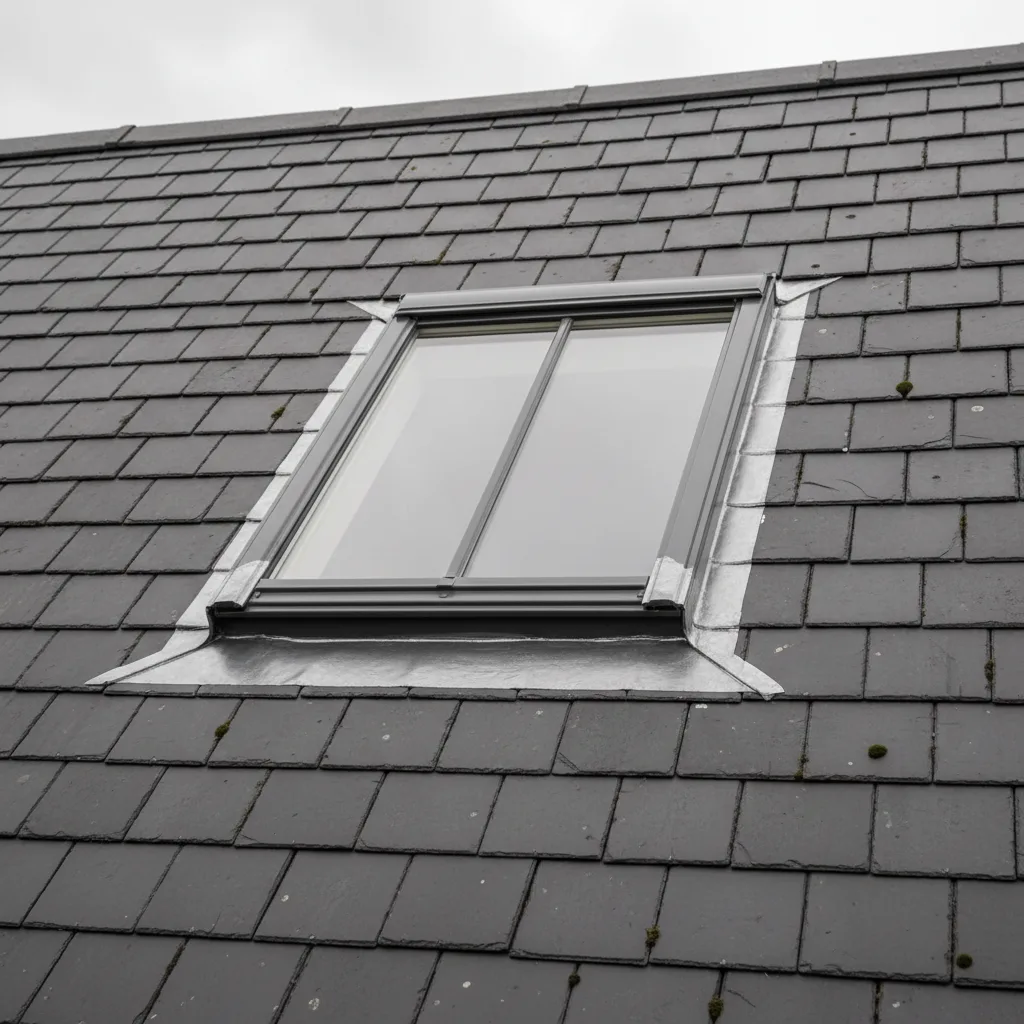
During that window rain is entering the room. In a light shower on a still day the amount is trivial and dries off a windowsill. In driving rain onto a wide open sash it is not trivial, and a floor directly beneath will get wet. This is the single most important thing to understand: a rain sensor limits the damage, it does not prevent water entering. Anyone who plans a room on the assumption that an open rooflight is protected by its sensor has misread the device.
Dew, frost and morning false triggers
Condensation forming on a cold pad on a clear night looks identical to fine rain as far as the electronics are concerned. On an unheated sensor this produces closure at dawn in autumn and spring, which for most households is invisible because the unit was shut anyway.
Where it becomes noticeable is on a unit left open overnight in summer for cooling. It closes at three in the morning as the roof surface drops below dew point, and the room is warm by seven. A heated pad largely removes this. So does the more prosaic answer of setting a schedule that closes the unit before dawn on purpose, which our page on remote controls, wall switches and smart home links covers.
What the sensor ignores completely
The list of things a rain sensor does not detect is longer than the list of things it does.
- Wind. No part of a standard rain sensor measures air movement. A sash held open in a gale on a dry day is a load on the mechanism and the hinges, and nothing will close it for you.
- Snow. Dry powder snow can land on a pad without wetting it. It becomes rain to the sensor only once it melts, by which time the sash edge may already be carrying it.
- Leaves, blossom, pollen and dust. An open rooflight under a lime tree collects what falls, and the sensor is indifferent.
- Insects and birds. Same answer.
- Security. An open unit is an open unit. The sensor is not a lock and does not close the unit because nobody is home.
- Humidity indoors. It faces outward. It knows nothing about the shower running below it.
Sensor position relative to the opening edge
Where the pad sits on the frame changes when it triggers, and installers who move sensors around without thinking cause problems.
Mounted on the hinge side of a top-hung unit, the open sash acts as a small umbrella over the pad in rain arriving from that direction. The sensor then reads a delayed and weaker signal than the aperture is actually receiving. Mounted on the opposite side, or on the head of a centre-pivot unit, it is fully exposed and reads early. Manufacturers position integrated sensors deliberately for the geometry of their own unit, which is a strong argument for taking the factory option rather than adding a generic sensor to a unit that was not designed for one.
Rain sensors on flat-roof units
Flat-roof rooflights lift on arms rather than hinging like a window, and the vent opening is a gap around some or all of the perimeter. That changes the calculation.

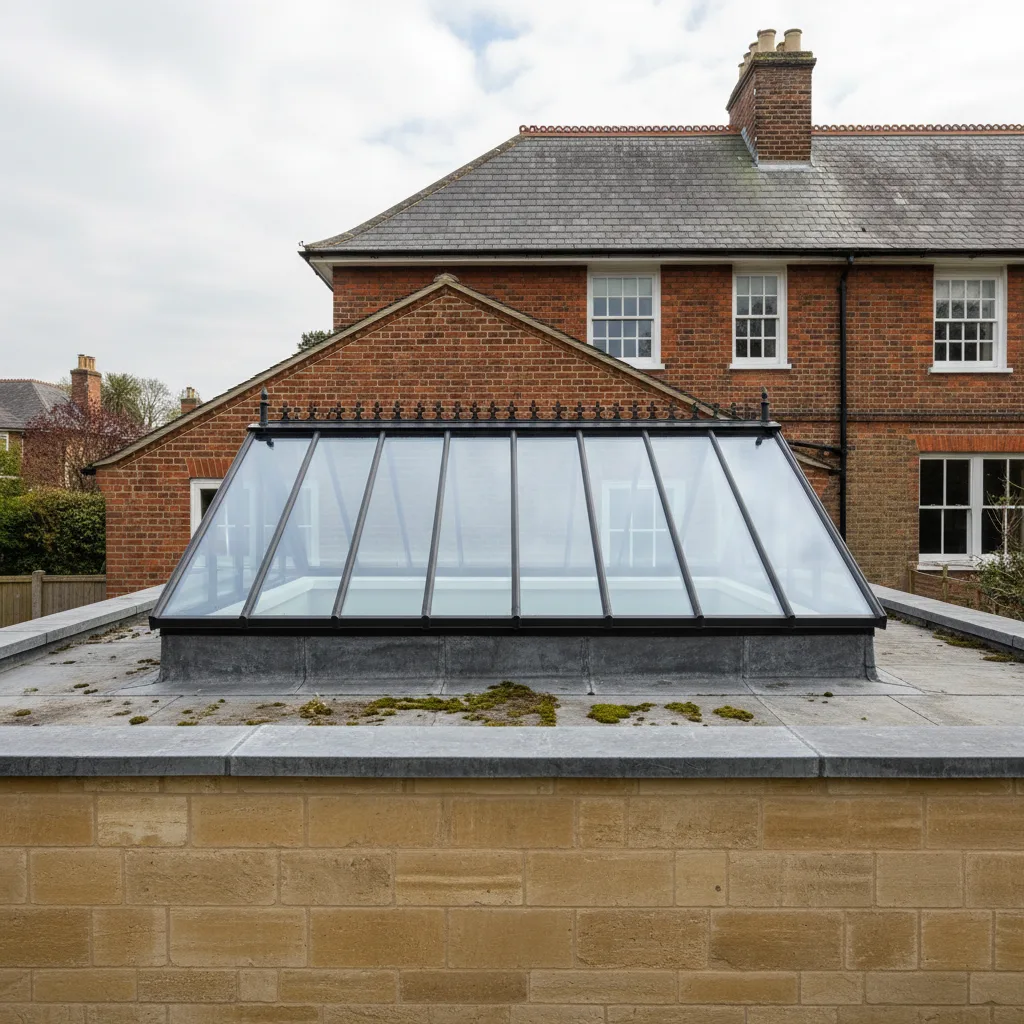
The open gap is often small, 100mm to 200mm, and it faces sideways rather than upward, so a vertical fall of rain enters far less readily than it does through an open roof window. That does not make the sensor redundant, because wind-driven rain arrives at an angle and Oxfordshire gets plenty of it. Sensor position on a flat-roof unit is usually on the upstand cover, and it needs to be somewhere that is not shielded by the raised glass and is not sitting in a puddle. A pad in standing water signals permanently, and the unit will never open again until somebody finds it.
Power, and the state the unit fails to
The sensor depends on the same supply as the actuator. Cut the power and the sensor stops watching.
What matters is the state the unit is in when that happens. A closed unit stays closed and nothing is lost. An open unit stays open, and it will still be open when the rain arrives, because the self-locking gearbox holds position and nothing can drive it. This is the strongest practical argument for battery backup on any unit that is genuinely left open unattended, and it is dealt with fully on our page about backup power and what happens in a cut. It is also a reason to be deliberate about leaving a rooflight open when the house is empty for days.
Keeping the pad working
The pad is a small flat surface on a roof, so it collects the same film of dust, pollen and algae as everything else up there. A dirty pad reads late, or reads permanently.
Cleaning is a soft damp cloth and nothing else. No solvents, no abrasive pad, no wire brush across the tracks, no jet wash. On an accessible unit this is a two-minute job once a year, done at the same time as wiping the glass. On a high unit it is part of whatever access arrangement already exists for cleaning, because nobody should be improvising a ladder for a sensor. A pad that has been scoured until the tracks are damaged is a replacement item, not an adjustment.
Testing that it actually works
A rain sensor is easy to test and almost nobody does it.
With the unit open, wet the pad with a damp cloth or a splash from a bottle. The sash should begin closing within a few seconds. That single test proves the pad, the wiring, the controller and the actuator as a chain. We do it at handover on every powered unit we fit, and it is worth an owner repeating it once a year, ideally in autumn before the weather that matters. If nothing happens, the fault is diagnosable: try the wall control to confirm the actuator responds at all, which separates a sensor problem from a drive problem.
Sensors, blinds and other devices on one controller
Where a unit has both a powered sash and an electric blind fitted inside the rooflight, they usually share a control system but not a trigger. The rain input closes the sash. It does not, and should not, move the blind.
Some smart controllers allow a rain event to trigger a wider scene, closing several units and sending a notification to a phone. That is genuinely useful in a house with rooflights in rooms nobody visits daily. It is also a layer that depends on a network and an account, so it belongs on top of the hard-wired sensor logic rather than in place of it.
Where a sensor changes the specification, and where it does not
A rain sensor is worth having on almost any powered rooflight, and on some it is close to essential: a unit over a stairwell that gets left open, a bedroom unit used for night cooling, a kitchen unit above a run of cabinetry, any unit above a timber floor. On a flat-roof vent over a utility room that gets opened for ten minutes while someone is standing under it, it adds little.
What a sensor does not do is change any of the detailing that keeps a rooflight dry in the first place. Upstand height, falls, flashing laps and where the roof covering terminates are what decide whether water gets in through the perimeter, and those four details are the reason our workmanship is guaranteed for ten years. A sensor is a convenience on the operating side of the unit and nothing more. Our page on whether you need a rain sensor takes the buying decision on its own terms.
How we specify and commission sensors
At survey we ask two questions: will this unit ever be left open when nobody is watching it, and what is under it. Those two answers decide whether a sensor is specified, and they are usually more informative than any preference expressed in advance.
Where a sensor is included it is ordered with the unit rather than added afterwards, so that the pad sits where the manufacturer intended and the wiring is inside the sealed envelope. The mains side of the supply is connected and certified by a qualified electrician. We fit the unit, weather it, and prove the sensor with water at handover in front of you. We install and replace rooflights across Oxford and 25 miles by road. Call 01865 704245 or email info@heritageskylightsoxford.co.uk for a range by email and a fixed price after a survey.
Four steps, no surprises
Survey
We look at the roof, the covering and the slope before we say anything about price.
Specification
The right unit and glazing for that roof and that orientation, in plain terms.
Fixed quote
Written, itemised and firm. The number does not move once work starts.
Install
Opening formed, unit set and weathered, covering made good. Notification is ours.
Helpful reading on this
Costs, comparisons and the questions we are asked most.
Tell us about your roof
We start with the building, the covering and the slope. Then we tell you what will suit it, and what it will cost, as a fixed written number.
- Surveyed before it is priced
- 10-year workmanship guarantee
- Building Control notification handled
- New installations and replacements