
An ordinary domestic electric rooflight has no backup power. When the supply goes off the actuator stops where it is, the control does nothing, the rain sensor stops sensing, and the sash stays exactly as it was until the power comes back. For most households in most power cuts that is a non-event, because the unit was shut anyway. It stops being a non-event when the sash was open, when the weather is turning, when the unit is five metres above a stairwell, or when the rooflight is the escape opening from a bedroom. This page is about the backup options that do exist, what each one actually buys you, and how to specify a house so that a cut never becomes a problem in the first place. The short version of what a cut does is on what happens to an electric rooflight in a power cut.
Why the sash stops rather than falls
The reassuring part of the answer is mechanical. Chain and rod actuators used on roof windows are non-backdriveable: the gearing between the motor and the chain will not let an external load push the chain back in. Take the power away mid-stroke and the sash holds its position rather than dropping.
That matters for safety. A large top-hung sash carries real weight, and a mechanism that let go when the supply failed would be unacceptable in a domestic ceiling. It also means a cut cannot slam a window shut on anything.
The consequence is that a cut freezes the state of your roof. Whatever was open stays open, whatever was shut stays shut, and nothing moves until either power returns or somebody intervenes by hand.
What a battery backup unit actually is
Several manufacturers offer a battery backup accessory that sits between the mains supply and the control system. It is a sealed rechargeable pack, trickle-charged from the mains, that takes over when the incoming supply fails.
It is not a whole-house solution and it is not a generator. It is sized to give a limited number of operations of the units on that control system, typically enough to close everything and perhaps open and close again, rather than to run the roof normally for hours.
Availability varies by range and by control family, and some backup accessories are designed specifically for smoke ventilation control panels rather than for comfort ventilation. Confirm compatibility against the exact control system before assuming it exists for your units.
How long a backup pack really holds a unit
Manufacturers quote backup performance in operations rather than in hours, and that is the honest way to state it. A pack might be rated for a set number of full open and close cycles, or for a standby period measured in hours with a small number of operations at the end of it.
The reason is that an actuator draws current only while it is moving. A rooflight sitting still consumes almost nothing, so a pack that would run a motor continuously for ten minutes can sit on standby for many hours and still close a sash at the end.
The design intent, then, is not to keep operating the roof through a long outage. It is to guarantee that the roof can be closed once when the power goes, which is nearly always the operation that actually matters.
| Arrangement | What it covers | What it does not cover |
|---|---|---|
| No backup, mains only | Nothing during an outage | Closing an open sash, sensor response |
| Manufacturer battery pack | A limited number of operations, usually a close | Extended normal use, blinds on other systems |
| Solar unit with internal battery | Normal operation independent of the mains | Long spells with no daylight on the panel |
| Manual override on the sash | Closing by hand, at any time | Any unit that cannot be reached |
| UPS on the control transformer | Short outages and dips, keeps controls live | Long outages, and it needs its own maintenance |
Solar units are already off the mains
A solar-powered rooflight is the neatest answer to the whole question, because it never depended on the house supply to begin with. A panel on the sash charges a battery inside the unit, and the actuator, the control receiver and usually the rain sensor all run from that battery.
Cut the mains to the house and a solar rooflight carries on exactly as before. It will open, close, respond to its remote and respond to rain, and it will do so for as long as the battery holds charge, which under normal daylight is indefinitely.
The trade-offs belong to the daylight side rather than the power cut side: orientation, overshading and eventual battery replacement. Those are set out on are solar powered rooflights any good. For a household that is genuinely worried about outages, solar is worth considering before any backup accessory.
The manual override, and knowing where it is
Most powered roof windows can be closed by hand if the motor is disengaged or the chain released, and on many ranges this is a deliberate, documented feature rather than a bodge. It is also, for an in-reach unit, the most reliable backup that exists, because it needs no electricity and no battery and cannot fail to be available.
The problem is that almost nobody knows where the release is. It is demonstrated once at handover, on a day when nothing is wrong, and then forgotten for eight years until a January evening with no power and an open window.
Our practice is to show whoever lives in the house how the override works on the day, and to leave the manufacturer’s documentation with the unit rather than taking it away. The mechanism itself is described on can an electric rooflight be opened manually.
The sensor is asleep too
People assume a rain sensor is an independent safety device. It is not. On a mains-powered unit the sensor is part of the same low-voltage system as the actuator, and when the supply fails the sensor stops working with everything else.
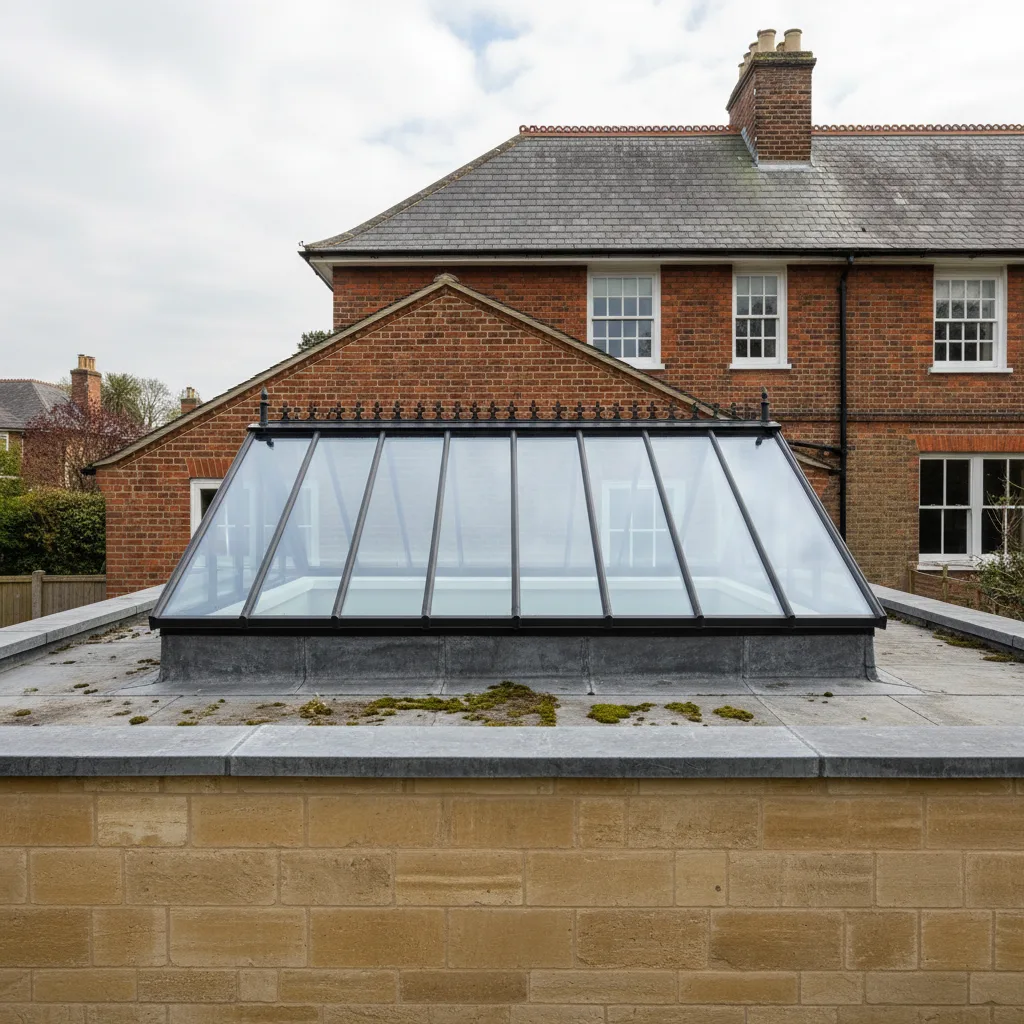
This is the specific combination worth worrying about. A sash left open, a power cut, and rain arriving an hour later. The sensor that would ordinarily have closed the window is dead, and unless somebody is in the house to close it by hand, the room takes the weather.
It is an argument for two things: closing units before leaving the house rather than relying on the sensor, and for taking backup seriously on any unit that is habitually left open. Storms and power cuts are correlated events, which is exactly why this scenario is not far-fetched.
Where the transformer lives, and why it matters in a cut
The transformer or power supply unit for a mains rooflight system usually sits in a loft, a cupboard or a service void near the unit. It has to be somewhere, and where it goes is decided at first fix, often without much thought.
In the context of backup that decision matters. A backup pack, if fitted, generally sits alongside the transformer, and the pack contains a battery that will need changing during the life of the installation. A transformer sealed into a warm roof build-up above a stairwell means that battery cannot be reached without an access tower and a hole in the ceiling.
Specify the position for accessibility: a loft hatch, a cupboard, a service void with a panel. It costs nothing at first fix and it is the difference between a ten-minute job and a morning’s work later on.
Isolation, and the switch nobody labels
The rooflight system is fed from a circuit in the consumer unit through a fused connection or an isolator. When the supply comes back after a cut, or when somebody has been working on the house, that isolator is the reason a rooflight sometimes appears dead when everything else has returned.
Have the isolator labelled and know where it is. A surprising number of “the rooflight has failed” calls resolve to a tripped circuit breaker or an isolator that was switched off during other work and never switched back.
Any work on the isolator, the circuit or the fixed wiring is for a qualified electrician. We set out where the supply arrives and where the transformer sits, and the electrician makes the connection and certifies that part of the work.
What happens the moment power returns
A rooflight does not reopen itself when the supply comes back. It stays where it is and waits for a command, which is the correct behaviour and the one you want at three in the morning.
A few other things may need attention. Any schedules or timers held in a control unit or a smart home hub may have lost their clock and will need resetting, particularly on older kit without a real-time clock backup. Wireless controls remain paired through an outage in almost every case, since the pairing is stored in non-volatile memory, but occasionally a receiver needs a moment to come back on line.
Anything running through a home automation hub depends on that hub, its network and its own boot sequence. A rooflight that answers a wall switch will work the instant power returns. One that only answers an app may take several minutes longer, and that is a reason to keep the wall switch.
A UPS on the control side, and whether it is worth it
Some people ask about putting a small uninterruptible power supply on the rooflight transformer. It works, technically. A modest UPS will hold the control system through brief interruptions and voltage dips, and will give enough capacity to close a unit or two.

Whether it earns its place is another matter. A UPS is another box with another battery that needs replacing, and it has to live somewhere accessible and ventilated. For most households a manufacturer’s backup accessory, where one exists for the range, is neater and better matched.
Where a UPS does make sense is a house that already has one for other reasons, such as a network cabinet or a home office, and where the rooflight transformer happens to be nearby. In that case adding the load is trivial and worth doing.
Smoke ventilation is a separate world
Rooflights used as smoke ventilators in stairwells of flats and larger buildings are a different category with their own rules. Those systems are required to have battery backup, standby duration, dedicated control panels and periodic testing, all specified against fire safety requirements rather than against comfort.
That is deliberately outside what we do. Our scope is domestic rooflight installation and replacement, and a smoke ventilation system is a life safety installation designed and commissioned by specialists in that field.
The reason it matters here is that internet advice about backup for rooflights frequently comes from that world, and the standards quoted do not apply to a comfort vent in a family house. Do not assume your kitchen rooflight needs, or can have, what a residential block’s stair vent has.
Escape windows and the questions to put to Building Control
Where a roof window provides the escape opening from a habitable room, usually a loft bedroom, a power cut takes on a different weight. An escape opening has to be operable by an occupant in an emergency, and an emergency and a power cut can arrive together.
This is not something to settle from a website, ours included. It is a matter for whoever is designing the conversion and for Building Control, and the answer may be that the escape unit must be manually operable without any reliance on power, or that a specific override arrangement is acceptable.
What we can say is procedural: establish whether escape is in play before choosing any unit, because it overrides preference on hinge, size, position and power. On our installations the Building Control notification is handled as part of the job and the specification is agreed against what the room actually requires.
Batteries are consumables, and they age quietly
Every backup arrangement described here contains a battery, and every battery has a working life. A sealed backup pack, a solar unit’s internal cell, a UPS, and the cells in the handheld remote all degrade whether they are used or not.
The failure mode is the awkward one: it degrades silently and reveals itself only when called upon, which is precisely the moment you needed it. A backup pack that has quietly lost its capacity over six years is worse than no backup, because it has been providing false confidence.
Treat replacement as scheduled work rather than as a response to failure. Note the installation date somewhere you will find it, check the manufacturer’s stated life, and change the pack on that basis. The wider routine is on maintaining an electric rooflight mechanism.
Designing a house where a cut is uneventful
The most effective backup strategy is usually not a battery at all. It is a specification that leaves you unbothered by an outage.

Four decisions do most of it. Keep at least one opening in every important room that works without electricity, whether that is a manual window or a powered unit with a reachable override. Specify solar rather than mains where the roof orientation allows it and no cable route exists. Put a wired wall control on every powered unit so nothing depends on a hub or a phone. And keep the transformer and any backup pack where a person can reach them.
The blunt version is that a house where every roof opening is mains-powered, high up, and controlled only through an app has arranged its own single point of failure. Mixing the specification is cheaper than engineering around it.
Settling the backup question before the plasterboard goes up
Everything in this page is easy before the ceiling closes and expensive afterwards. The cable route, the transformer position, the isolator location, the wall control positions and the decision between mains and solar all have to be made while the roof structure is still open.
At survey we ask what the room is for, whether escape is involved, whether anybody could reach the sash without power, and how often the unit is expected to be left open when the house is empty. Those four answers usually decide the backup specification without anybody needing to read a datasheet.
We then set out the route and the positions on site, sequence the work with a qualified electrician who makes the connection to the fixed wiring and certifies it, and hand over with the override demonstrated. The roof is never left open overnight. As always, the figures come in two stages: a range by email, then a fixed price after the survey.
Four steps, no surprises
Survey
We look at the roof, the covering and the slope before we say anything about price.
Specification
The right unit and glazing for that roof and that orientation, in plain terms.
Fixed quote
Written, itemised and firm. The number does not move once work starts.
Install
Opening formed, unit set and weathered, covering made good. Notification is ours.
Helpful reading on this
Costs, comparisons and the questions we are asked most.
Tell us about your roof
We start with the building, the covering and the slope. Then we tell you what will suit it, and what it will cost, as a fixed written number.
- Surveyed before it is priced
- 10-year workmanship guarantee
- Building Control notification handled
- New installations and replacements