
Every rooflight on the market falls into one of three groups: it does not open at all, it opens by hand, or it opens on a motor. That single choice affects what the unit costs, how many parts it carries, how much of the specification has to be settled before the ceiling closes, and whether the ventilation you paid for actually gets used. It is also a choice people make late, usually after the size and the position are already settled, which is the wrong way round for anything electric. What follows is what each group is genuinely for, where each one earns its place, and the few situations where the decision is taken out of your hands.
Three categories, three jobs
Non-opening, manual and electric are not three grades of the same product. They answer different briefs, and the right one depends on what you want the rooflight to do beyond letting light in.
A rooflight can be asked to do three separate things. It can deliver daylight, which every unit does. It can move air, which only an opening unit does. And in a habitable room it may need to provide an opening somebody can get out of, which is a matter for the designer and Building Control rather than a preference. Being clear about which of those apply is most of the decision, because each one narrows the range differently.
A useful discipline is to write the brief down as a sentence before looking at any product. A landing that is dark and already ventilated by the stair wants daylight and nothing else. A shower room wants daylight and reliable air movement in a place nobody will reach easily. A converted loft bedroom may want daylight, air and an escape opening from the same unit. Those three briefs produce three different orders, and none of them is arrived at by choosing a specification level from a price list.
The other thing worth saying at the outset is that how a unit is powered and how it hinges are separate questions. People routinely conflate them, and the conflation costs money.
The case for a fixed light
A non-opening rooflight, usually called a fixed light, is a sealed unit in a frame with no sash, no hinge, no mechanism and no handle. It is the simplest thing in the category and, where the brief is purely daylight, it is often the correct answer rather than the cheap one.
Three things follow from having no moving parts. It costs less than an equivalent opening unit, so more of the budget goes into glazing and detailing where it does more good. It has fewer components capable of wearing out, because there is no mechanism cycling, no hinge carrying a load and no perimeter seal being compressed and released through the seasons. And it has fewer air paths, since a fixed frame is sealed once at manufacture rather than relying on a gasket meeting a sash every time somebody shuts it.
That last point matters more in a well-insulated room than people expect. Airtightness is where a lot of heat quietly leaves a modern build-up, and an opening unit that is never opened is an air path bought for nothing.
The honest limitation is that a fixed light does absolutely nothing about air, heat or access. If the room has no other ventilation, or if the rooflight is the natural place to let summer heat out at high level, a fixed unit hands that problem to something else in the room. It is worth asking where the air is coming from before settling on one, not afterwards.
Hand and pole operation
Manual opening covers two arrangements that behave very differently in daily use, and lumping them together is why some people end up disappointed.
The first is a unit within reach. A handle on the sash, at the head or at the foot depending on the design, opened and closed by hand from where somebody stands. In a converted loft bedroom with a window set low in the slope, or over a flat-roof kitchen with a low ceiling, this is the whole answer. It is cheap, it is instant, it needs no cable, no supply and no coordination with anybody, and there is nothing to go wrong that a person cannot see.
The second is a unit out of reach, opened on a pole with a hook or a spindle. The mechanics work perfectly well. What is less reliable is the human being. A pole has to live somewhere, it has to be fetched, and it has to be used with both hands above head height. It is worth being honest about the consequence: a vent that needs a pole fetched from a cupboard tends to stay shut, particularly in winter when it is most needed for moisture and least attractive to operate.
That is not an argument against pole operation everywhere. In a hallway or a store, occasional use is genuinely all that is wanted. It is an argument against specifying it in a room where ventilation has an actual job to do, such as a bathroom or a kitchen, because the specification will be defeated by ordinary human behaviour.
Where a motor is justified
An electric unit replaces the handle with an actuator, a supply and a control. It costs more than either alternative and adds components, so it should be specified where it does work rather than as an upgrade.
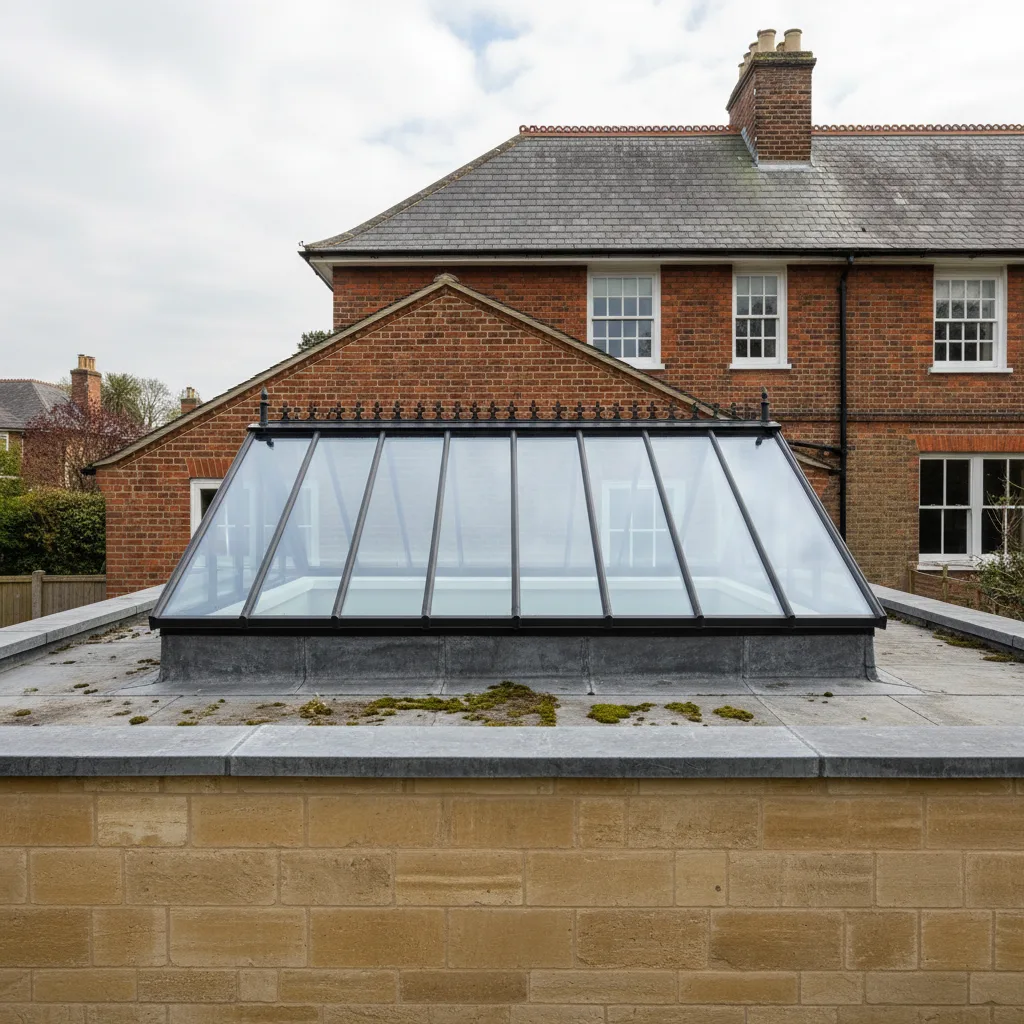
Three situations justify it plainly. The first is height: a unit genuinely out of reach, over a stairwell, in a double-height space or high in a vaulted ceiling, where a pole is either impossible or unsafe. The second is ventilation that has to be used rather than merely available, in a shower room, a kitchen or a bedroom that overheats, where making the action effortless is the difference between the vent working and the vent existing. The third is number: where several units are to be opened together, operating them individually stops happening after the first week.
The cost that surprises people is not the motor. It is the cable. A supply has to reach the unit, and the route has to be planned before insulation and plasterboard close the ceiling. Deciding on electric operation after the ceiling is finished usually means either surface trunking or opening work that was already complete.
We install the rooflight, set out the cable route with the ceiling still open, and work alongside a qualified electrician who makes the connection to the fixed wiring and certifies that part of the work. The two trades have to be sequenced together, which is a scheduling matter worth raising at survey. Our electric skylight installation page covers actuators, supplies, controls and commissioning in detail.
Hinge is a separate question
Centre-pivot and top-hung describe how a sash moves. Manual and electric describe what moves it. They are two independent axes, and most ranges offer both hinge types in both manual and powered versions.
The practical consequence is that you should settle the hinge on the room and the wall, then settle the power separately. A window somebody stands at and looks out of, low in a slope, argues one way. A high window where the outside face has to be cleanable from indoors argues the other. Our guide to roof windows and rooflights sets out the trade-off between the two mechanisms in full, and it does not change because a motor is involved.
What does change is worth noting. A powered unit removes the reach argument almost entirely, since nobody has to be able to touch the handle, which frees the hinge choice to be made purely on how the room is used and what is outside. It also removes the awkwardness of a heavy sash at the top of a pole, which on a large top-hung unit is a real consideration.
On flat roofs the vocabulary changes again. Flat-roof units generally lift on an arm rather than hinging like a window, and many are offered only as fixed or only as powered vents, so the hinge question does not arise in the same form. Establish early which arrangement a given range actually offers, because assumptions carried over from pitched roofs do not hold.
Sensors, and what they miss
Most powered rooflights can be supplied with a rain sensor, and it is a genuinely useful thing to have. It is also routinely misunderstood, and the misunderstanding leads people to leave units open in circumstances they should not.

What it does is simple. A small pad on the outside of the frame detects moisture landing on it and signals the unit to close. Left open on an ordinary day, the rooflight shuts itself when rain arrives, and a room is not soaked because somebody went out.
What it does not do is worth stating plainly. It reacts rather than predicts, so rain reaches the pad before the sash starts moving, and a closing cycle takes time. In heavy or wind-driven rain, water can enter during those seconds. It responds to water, not to weather generally, so it does nothing about wind, and an open sash in a gale is a load on the mechanism whether it is raining or not. It knows nothing about leaves, pollen, dust or insects. It is not a security device, and an open rooflight is an open rooflight. It also depends on the unit having power, so behaviour during a power cut is a fair question to ask about any particular product.
Treat it as a safety net for the times somebody forgets, which is exactly what it is good at, rather than as a reason to leave a unit open when nobody is in the house.
A switch on the wall
Powered rooflights are controlled in three broad ways: a wall switch or keypad, a handheld remote, or an app on a phone. Most ranges offer more than one, and the sensible specification usually includes more than one.
The case for a physical control fixed to the wall is that it works for everybody. A visitor, a child, a cleaner, a relative staying the weekend, somebody whose phone is flat: all of them can operate a switch without being told anything. It cannot be lost down the side of a sofa, it does not need a network, it does not depend on an account, and it does not stop working because a manufacturer retired an application. Position it near the door of the room, where a light switch would go, so that using it is on the way past rather than a detour.
Remotes and apps add genuine convenience on top of that. An app can close everything from downstairs, group several units together, and set a schedule so a bedroom vents on a summer afternoon before anybody is home. A remote suits a room where the switch ended up on the wrong wall.
The order matters, though. Build the installation around a control that is fixed to the wall and wired, then add the wireless layers as conveniences. A house where the only way to close a rooflight is an app is a house with a single point of failure in its roof.
When escape decides for you
There is one situation where the whole of the above becomes advisory: where the rooflight is providing an escape opening from a habitable room.

In loft conversions particularly, a roof window is frequently the unit relied on for escape from the new room. Where that applies, an opening unit is required whether or not anybody wanted ventilation, and the unit has to give a clear opening of a size and at a height that the designer and Building Control are satisfied with. That has knock-on effects across the choice: it usually points towards a hinge arrangement leaving the aperture clear, it sets a floor under the size of unit that can be used, and it constrains where on the slope the unit can sit.
It also interacts with power. Whether a powered unit is acceptable in that role, and what happens to it in a power cut, is something to settle with whoever is designing the conversion rather than to assume. Some arrangements need a manual override that anybody can operate without thinking.
What we can say usefully is procedural. Establish whether the room is habitable and whether escape is in play before any unit is chosen, because that answer overrides preference. On our installations the Building Control notification is handled as part of the job, and the specification is agreed against what that room actually needs rather than what looked best in a brochure.
Four steps, no surprises
Survey
We look at the roof, the covering and the slope before we say anything about price.
Specification
The right unit and glazing for that roof and that orientation, in plain terms.
Fixed quote
Written, itemised and firm. The number does not move once work starts.
Install
Opening formed, unit set and weathered, covering made good. Notification is ours.
Helpful reading on this
Costs, comparisons and the questions we are asked most.
Tell us about your roof
We start with the building, the covering and the slope. Then we tell you what will suit it, and what it will cost, as a fixed written number.
- Surveyed before it is priced
- 10-year workmanship guarantee
- Building Control notification handled
- New installations and replacements