
Islip sits where the Ray meets the Cherwell, on low ground in a broad flat valley, and that position gives it a colder microclimate than the villages on the higher ground a couple of miles away. On a still clear night the cold air drains down off the slopes and pools in the valley bottom, and the roofs in it are the last things in the county to lose their frost. For a rooflight, a cold site is not a difficulty so much as a specification, and this page is about what changes when your roof is a few degrees colder than the forecast suggests.
A village in a frost hollow
Cold air is denser than warm air, so on a clear still night it flows downhill and collects in the lowest ground available. Valleys with slow-moving rivers and flat floors, which is exactly what the Ray gives Islip, hold that pooled air until the sun is high enough to break it up.
The practical effect is that the village routinely records lower overnight minima than land a short distance away and higher up, that frost forms earlier in the autumn and persists later into the spring, and that mist sits over the meadows on mornings when the surrounding countryside is clear.
It is a genuinely pleasant place to live and it is a slightly harder environment for glass than the average. It is worth designing for rather than discovering.
What a cold clear night does to a rooflight
Any glass aimed at the open sky loses heat by radiation, and on a clear night the sky behaves as a very cold surface. A rooflight can therefore drop below the temperature of the air around it, which is why frost forms on a car roof and not on its doors.
Put that effect in a valley where the air itself is already several degrees colder than the surrounding land, and the inner face of the glass in an Islip roof is genuinely the coldest surface for some distance.
The consequence is condensation, earlier in the season and more persistently than the same unit would produce in Kidlington or on the higher ground at Noke. Nothing is wrong with the rooflight. The physics is simply working harder here.
What to specify differently on a cold site
Four things, none of them exotic, and all of them decided at order rather than afterwards.
A better whole-unit U-value than you would otherwise settle for, which on an occupied room means triple glazing rather than double. The warmer the inner pane, the less readily it reaches the dew point of the air in the room, and on a cold site that margin is worth buying.
A warm-edge spacer without exception. The spacer separating the panes at their edge is where the coldest point of the glass sits, and a traditional aluminium one conducts heat straight around the cavity. On a cold site, the edge is where condensation appears first and where it persists longest, so moving the cold point is disproportionately effective.
A high g-value on any slope that gets sun. On a cold site the solar gain is a benefit rather than a nuisance, and there is no reason to specify a solar control coating on a north-facing or shaded slope here.
An opening unit rather than a fixed one wherever the room allows, because the ability to purge the air in five minutes is the most useful condensation tool available and it costs very little at order.
The reveal, which is where cold sites catch people out
Condensation on glass is normal physics and it clears. Condensation on the plaster around the glass is a detailing failure, and a cold site makes an ordinary detailing failure into an obvious one.
The insulation has to be carried tight to the frame on all four sides, without gaps and without being crushed into uselessness. The vapour control layer has to be sealed to the frame continuously, all the way round, rather than stopped short of it. The reveal itself has to be insulated rather than merely boarded.
Get any of that wrong in a warm sheltered spot and the owner may never notice. Get it wrong here and there is water running down the plaster by the second week of November, and the owner reasonably concludes the rooflight leaks.
Frost, thaw and the lead
The other thing a cold site does is cycle. Water that freezes overnight and thaws by mid-morning, repeatedly, through a long winter, is harder on a roof than a steady cold.
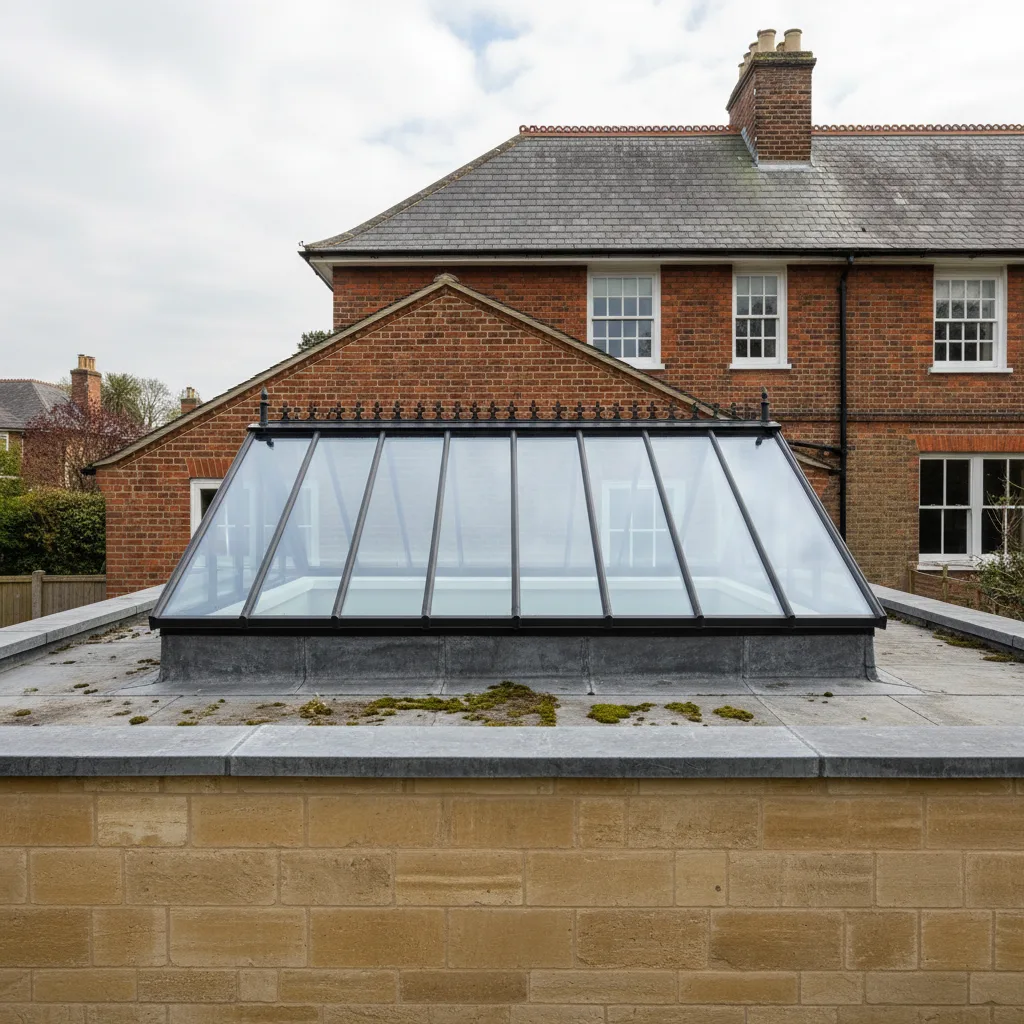
Freeze and thaw works at any material that has taken up water: old mortar, porous tile, and any lap where water can sit rather than run. It also exercises lead, which already moves substantially with temperature, through more cycles per winter than a warmer site imposes.
So the ordinary rules matter more rather than differently. Lead in short bays so it can move without splitting, fixed at the head only. Laps at the upper end of the range so nothing sits where it could freeze. Debris kept out of the drainage channels around the unit, because a channel with leaf litter in it holds water, and water that freezes in a channel expands.
Ventilation, which is the other half of the answer
Everything above manages the cold surface. The rest of the problem is the moisture in the air meeting it, and on a cold site the household habits matter more.
Extract at source in the kitchen and the bathroom, ducted to outside rather than recirculating through a filter, which removes smell and returns every gram of water to the room. Doors kept shut on wet rooms. Laundry dried outside or in a vented dryer rather than on a radiator, since a single load released indoors puts a couple of litres into the house.
And purge ventilation rather than a permanently ajar window: five or ten minutes of an opening rooflight fully open exchanges the air almost completely while barely cooling the fabric of the room, which is both cheaper and more effective than leaving something cracked all day.
The village fabric
Islip is small, stone-built, and largely designated: a conservation area covering the historic core, with a number of listed buildings within it. The authority is Cherwell District Council.
The older roofs are steep, hand-cut, with irregular rafter spacing and coverings of stone slate or later clay tile, often with no underlay beneath. Openings go where the structure permits, and the perimeter is hand-formed lead rather than a proprietary kit, because no kit is made for a graded stone roof.
Around the core there is later housing on concrete interlocking tile over trusses, which is ordinary work with a profile-specific flashing kit and no designation attached.
On a listed building, consent is engaged wherever the unit goes, including a rear slope nobody can see, because listing covers the whole building. In the conservation area, a slope facing a highway will usually need permission and a rear slope often will not.
What gets accepted here
Where a unit is accepted on a designated roof in Islip it will sit flush in the plane of the covering rather than proud of it, be finished dark, be modest in size, and often carry a single vertical glazing bar so it reads as a Victorian cast-iron light.

Position does as much work as product. A unit low on a rear slope, aligned with anything already on that roof, is a far easier conversation than one placed centrally on a plane visible across the meadows.
The one conflict worth knowing about is that conservation-grade units tend to have slimmer frames and narrower cavities, which means a worse U-value than an equivalent standard unit. On a cold site that is a real trade rather than a paper one, and the sensible response is to recover the performance in the surrounding build-up: better insulation in the roof around the opening, a properly insulated reveal, and a continuous vapour control layer sealed to the frame.
Damp ground, and what is not a roof problem
Low-lying villages on river ground carry higher humidity generally, and the older cottages have solid walls with no cavity and frequently no effective damp course.
That is not a rooflight matter, and it is regularly confused with one. What connects them is the moisture load in the air: a house with damp at ground level runs at a higher humidity throughout, so the air arriving at a cold rooflight is carrying more water than it would in a dry house and gives it up more readily.
The useful conclusion is that in a house like that, ventilation is not optional and a dehumidifier is treating a symptom. Fixing the ground-level problem changes the roof-level one.
Snow, and the load nobody accounts for
A frost hollow holds snow longer than the ground around it, because the pooled cold air keeps it from thawing while higher land has already cleared.
On a steep stone roof this makes little difference; snow slides off a 50 degree pitch quickly and the load never accumulates. On the shallower roofs of later additions and single-storey extensions it accumulates and stays, and it can sit for a week where a mile away it lasted a day.
For a rooflight the consequence is at the upstand. On any flat or near-flat roof the height of the kerb has to clear standing water and lying snow, which is exactly why the working minimum is 150mm from the finished surface rather than something lower. On a site that holds snow, that figure is a floor rather than a target, and shaving it to make a unit sit flusher is a decision that gets tested every winter.
Snow also loads a roof, and drifted snow loads it unevenly. Where a large unit is going into a shallow roof on an old structure, that is a survey question rather than an assumption.
Working here in winter
Most rooflight work happens outside the summer, and there is no reason it should not, but a cold site adds two practical constraints worth planning around.

The first is frost on the roof itself. A frosted slope is not safe to work on and it does not clear until the sun reaches it, which in a valley bottom in January can be late in the morning. So winter working days here start later than they do elsewhere, and a job that is one day in June may be a day and a half in December. That should be in the programme rather than discovered.
The second is that several materials have minimum application temperatures, and plaster drying slows considerably in a cold house. Neither compromises the work; both affect the calendar. Making good may sit a few days further behind the roof work than it would in September.
What does not change is the rule about the roof. It is never left open overnight, and it is never opened in conditions where it could not be closed again the same day.
What we fit in the village
New rooflights and replacements of failed units, in the cottages, the later houses and the converted outbuildings around the village. Conservation units where a designation calls for them, and glazing specified for this site rather than for the catalogue.
What we do not do is remedial roofing. On an old stone roof at the end of its life, the honest answer is that the covering needs attention before a new unit goes into it, and we will say so rather than take the work.
What to send us
Where in the village the building is, what the roof is covered with, whether it is listed or in the conservation area, and which room you are lighting. If the house already suffers from condensation anywhere, mention that too, because on a cold site it changes what we would specify rather than being a separate conversation.
Islip is a short drive from Oxford and comfortably inside the twenty-five miles of road we cover.
Four steps, no surprises
Survey
We look at the roof, the covering and the slope before we say anything about price.
Specification
The right unit and glazing for that roof and that orientation, in plain terms.
Fixed quote
Written, itemised and firm. The number does not move once work starts.
Install
Opening formed, unit set and weathered, covering made good. Notification is ours.
Helpful reading on this
Costs, comparisons and the questions we are asked most.
Tell us about your roof
We start with the building, the covering and the slope. Then we tell you what will suit it, and what it will cost, as a fixed written number.
- Surveyed before it is priced
- 10-year workmanship guarantee
- Building Control notification handled
- New installations and replacements