
Chipping Norton is the highest town in Oxfordshire, and the practical consequence of that is cold. Winters here run longer and harder than they do down in the Thames valley, with more frost and a heating season that begins earlier and ends later. A rooflight is the thermally weakest element in any roof, so the difference between an adequate unit and a well specified one is felt here daily rather than as a line on a datasheet. We install new rooflights and full replacements, and on a high Cotswold roof the specification is written for the winter rather than for the week the work happens.
The highest town in Oxfordshire
The town stands on high ground at the far western side of the county, in the Cotswolds proper, with the land falling away on more than one side. It grew as a wool town, and the market square and the streets running off it still hold the shape that trade gave them.
Height changes weather in two ways, and only one of them gets discussed. The first is movement of air, which is what people mean by an exposed site. The second, and the one that decides how a rooflight performs over its life, is temperature. Air is colder higher up. Frosts arrive earlier in the autumn and carry on later into the spring, and there are more days when conditions stay at or below freezing rather than lifting by mid morning.
Two things follow for a roof. It spends more of the year with a large temperature difference across it, so every weakness in the envelope is worked on for longer. And it dries more slowly, because a cold slope in damp air holds moisture where a warmer roof lower down would have shed it by lunchtime.
None of that argues against putting glass in a roof. The stone houses here are often deep in plan with small openings, and the months when they are darkest are the months being described. It argues for specifying properly. Rooflight installation in Chipping Norton is governed by the winter more than by anything else on the survey sheet.
Why cold changes the specification
A rooflight is an opening cut through the insulated envelope and filled with a manufactured object that will never insulate as well as the roof around it. That is not a criticism of any product: glass and a frame cannot match a rafter depth full of insulation. What a good unit does is narrow the gap.
In a mild, low-lying location that gap is a modest penalty over a short heating season. On a high Cotswold roof, with the heating running for more of the year, it becomes something felt: a cool zone of room under the glass on a still evening, a slope of ceiling that never comes up to the temperature of the rest, and running costs that are slightly higher every month rather than occasionally.
A bigger temperature difference does not only push more heat out. It pulls the internal surfaces of the unit colder, and internal surface temperature is what decides whether water forms on the inside.
So the choice is not between a basic unit and an expensive one for its own sake. It is between a unit chosen to satisfy the regulation on paper and one chosen for the conditions the roof will meet. Here the second is worth the difference, and we would rather explain why than quietly specify the cheaper option and let the winter make the argument.
The number that actually counts
Rooflights are sold on thermal figures, and two are in circulation. They are not the same number, and the difference matters more here than in most of the county.
The centre-pane figure describes the middle of the glass, the best performing part of the assembly, and nothing else. The whole-unit figure covers the finished product: glass, frame, the edge seal around the glazing and the way those parts meet. It is always the poorer of the two, and the one describing what will sit in your roof.
The frame and the edge of the glazing are where heat gets out, and over a long heating season that perimeter is losing it for months. Comparing one brand’s centre-pane figure with another’s whole-unit figure is not a comparison at all, and it is an easy trap when quotations arrive from different firms.
We will not print a target figure here, because the honest number is the one on the datasheet for the unit going into your roof. What we will do is quote on whole-unit terms, and put every option on the same basis.
| What the cold acts on | Why it matters at this height | What the specification does |
|---|---|---|
| The glazed unit | A longer season keeps the weakest element under load | Chosen on the whole-unit figure |
| Frame and glazing edge | The coolest internal surfaces, and where water forms first | Detailed for the build-up it sits in |
| The reveal lining | Its surface temperature decides whether condensation appears | Insulation tight to the frame, vapour control continuous |
| The flashing laps | Water held in a junction expands when it freezes | Generous laps rather than the minimum |
Where condensation actually starts
The reveal is the lining running from the frame of the unit out to the finished ceiling or wall face inside the room. It is usually treated as making good. On a cold roof it is a performance element, and the one most often got wrong.

Condensation is a surface temperature problem before it is a moisture problem. Every room has water vapour in the air; what decides whether you see it is whether there is a surface cold enough for that water to settle out onto.
Around a rooflight those cold surfaces are made by thermal bridging: a path through the envelope that conducts heat faster than the fabric either side of it. Insulation stopped short of the frame at the head of the opening. A timber running from outside to inside with nothing over it. A void behind the plaster that lets room air reach cold structure.
In a mild location such a detail may sit just above the threshold for its whole life and never declare itself. Here it sits below that threshold for weeks at a time, and the owner sees a dark line in the corner of the lining and reasonably concludes the unit is letting water in. Often it is not. The building is making that water on the inside.
That is why insulating the reveal properly is not optional detailing in this town. Insulation is carried tight to the frame on all four sides including the head, the vapour control layer is made continuous and sealed to the frame rather than tucked near it, and no cold structure is left in contact with room air.
Frost, thaw and lying snow
Freezing conditions act on junctions, and a rooflight is a ring of junctions cut into a roof.
Water that finds its way into a lap, a fold in the lead or a bed of mortar will sit there. When it freezes it expands and pushes whatever contains it slightly apart. Then it thaws, more water gets into the slightly larger space, and the next frost pushes harder. A detail that keeps a roof dry through a mild winter can be opened up by a run of hard ones, because the mechanism does not need the detail to be bad. It only needs somewhere for water to be held.
The response is not a product. It is generosity in the detailing. Laps deeper than the minimum that would technically work. Lead dressed so water runs off it rather than standing in it. Terminations that throw water clear instead of letting it hug the surface.
Snow does something related but distinct. A pitched roof up here holds snow longer than one in the valley, and snow lying against a unit means prolonged wetting rather than the quick shed a roof is designed around. The melt begins at the warmer surface underneath, so meltwater travels as a film beneath the covering, moving under laps rather than over them, which is the one direction the geometry does not allow for. Position and the head detail above the unit are therefore worth deciding deliberately.
Working through a Cotswold winter
Half of the trust in this job is about the days the roof is open.

Our method is the same everywhere. An opening is formed, made weathertight and closed within the working day, so the house is dry and secure overnight rather than sheeted and hoped over. What changes on a high Cotswold roof in January is how many days are suitable for starting at all.
Frost on a slope is a safety matter for the people standing on it. Strong wind makes handling boards, coverings and a glazed unit at height unsafe. Driving sleet gets into an open roof faster than it can be closed. Adhesives and sealants have conditions below which their manufacturers do not warrant them, and those are the manufacturer’s limits rather than an excuse of ours.
So we will not open a roof in unsuitable conditions, and we would rather move a date than start on a morning that is going to turn. We say that at booking rather than on the day. Work that does not need the roof open carries on regardless.
None of this means winter is a bad time to have the work done; it is often when an owner most wants the light. It means the programme is discussed honestly at the start, rather than promised and moved.
Stone, designation and West Oxfordshire
Chipping Norton is a stone town, and unusually consistently so. Walls, boundaries and roofs come from the same family of material from the market square outwards, and a large conservation area covers the historic core, with listed buildings inside it.
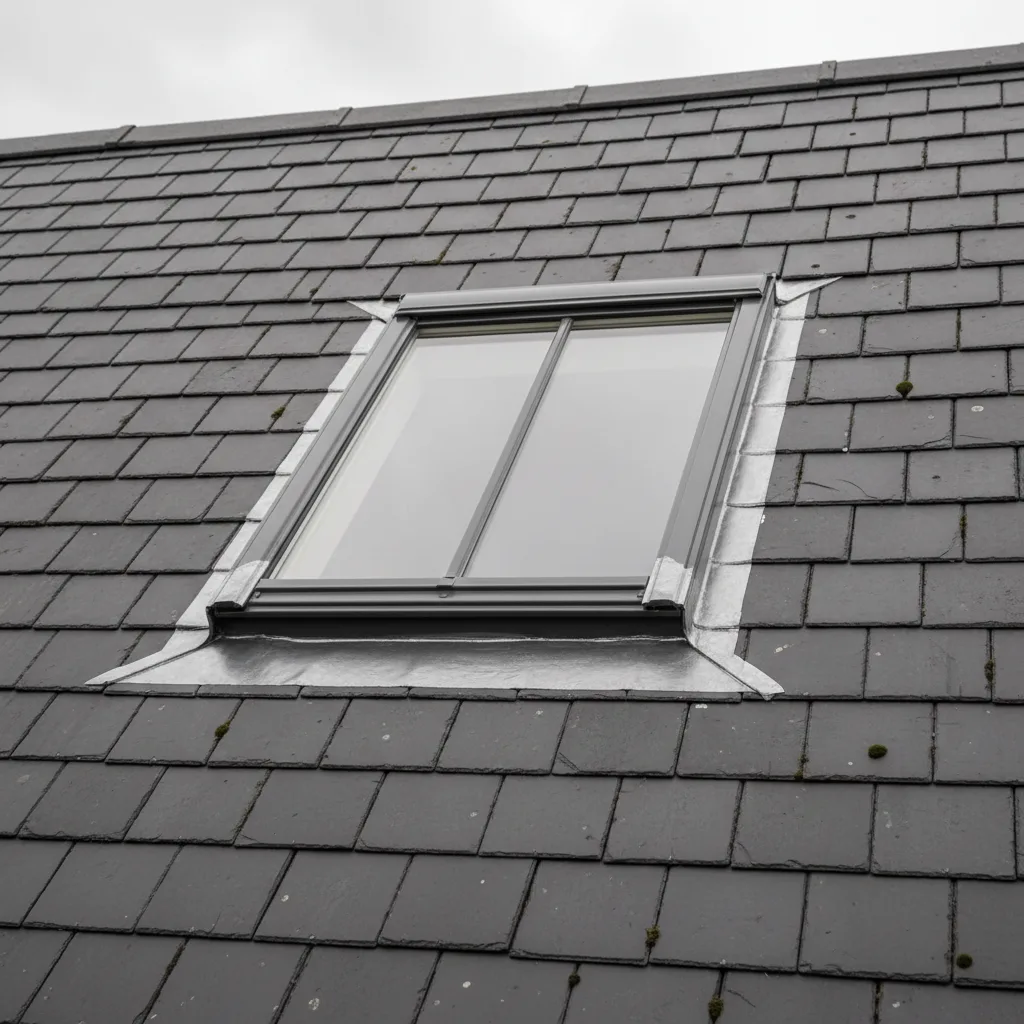
What follows for a rooflight is that appearance becomes a material consideration in its own right, alongside the technical questions. The usual answer in this stock is a flush conservation-pattern unit, dark finished, set into the plane of the covering rather than standing above it, often with a single vertical glazing bar.
There is a useful coincidence in that, and it is specific to a cold town. The flush detail is also the better thermal detail. A unit sitting within the plane has its frame surrounded and sheltered by the covering instead of standing proud in open air, so there is less exposed frame perimeter for the weather to work on.
The planning authority for a Chipping Norton address is West Oxfordshire District Council. Conservation area status and listed status are matters of public record, established at the address rather than judged from the look of a building, and listed building consent is separate from planning permission. We install rooflights and we are not the authority. We will tell you the position your building is likely to be in and which specification usually satisfies it.
What a Chipping Norton survey covers
A rooflight installation here starts with the roof build-up and the winter, not with the product.
Where the insulation line runs. Whether the roof is insulated at ceiling level with a cold void above, or at the rafter line as a warm build-up, because that decides where the reveal insulation meets the unit and where the vapour control layer has to be made continuous. It cannot be settled from the ground.
The covering and the junctions. What the roof is finished in, the pitch, rafter depth and spacing, and how the laps around the intended opening will be formed. On a replacement, the condition of the existing upstand, because a new unit set on an unsound upstand inherits everything underneath it.
Orientation, and what you want from the light. In a cold town winter sun through the glass is a gain rather than a nuisance, so the heaviest solar control glazing on a north-facing slope takes away warmth you would rather keep. A south-facing slope is a genuine balance rather than a default.
The unit, the designation and the season. Options compared on whole-unit terms, opening type chosen for how the room is used, conservation area or listed status established before anything is fixed, and a realistic date for the season. We install VELUX, Fakro, Keylite and Roto units.
We handle the Building Control notification as part of the job, and our workmanship carries a ten-year guarantee with coverage and exclusions written out on its own page. We have been installing rooflights for fifteen years. Chipping Norton sits at the far western edge of the twenty five mile road radius we work from Oxford, which is worth stating. New installations and full replacements only, which is a deliberate scope.
Four steps, no surprises
Survey
We look at the roof, the covering and the slope before we say anything about price.
Specification
The right unit and glazing for that roof and that orientation, in plain terms.
Fixed quote
Written, itemised and firm. The number does not move once work starts.
Install
Opening formed, unit set and weathered, covering made good. Notification is ours.
Helpful reading on this
Costs, comparisons and the questions we are asked most.
Tell us about your roof
We start with the building, the covering and the slope. Then we tell you what will suit it, and what it will cost, as a fixed written number.
- Surveyed before it is priced
- 10-year workmanship guarantee
- Building Control notification handled
- New installations and replacements