
The glass specification is the single decision on a roof lantern that cannot be revisited. Frame colour can be changed at a cost, vents can be retrofitted with difficulty, blinds can be added later. The glass is bonded into sealed units, lifted onto a roof and dressed in, and changing it means a second installation. This page explains what the units are made of, what the numbers on a specification mean, and what to ask for on a lantern facing the Oxford sky.
What a lantern unit is actually made of
A roof lantern facet is a sealed double glazed unit, typically 28mm overall, built from an outer pane, a spacer bar holding a cavity of gas, and an inner pane. Around the perimeter sits a primary butyl seal against gas loss and a secondary structural seal holding the sandwich together.
The outer pane is toughened, usually 6mm. The inner pane is laminated, usually 6.4mm or 8.8mm, made of two sheets of glass bonded to a plastic interlayer. The cavity is 16mm and holds argon rather than air.
Every performance number a supplier quotes comes from choices within that sandwich: which surface carries which coating, what gas fills the cavity, and what the interlayer is made of. Nothing about the appearance of the glass tells you what is in it.
The surfaces are numbered, and the numbering matters
Glaziers count surfaces from outside in. Surface 1 is the face exposed to the weather. Surface 2 is the inside of the outer pane, facing the cavity. Surface 3 is the cavity side of the inner pane. Surface 4 is the face you can touch from the room.
Solar control coatings live on surface 2, because they need to reflect and absorb energy before it enters the cavity. Low emissivity coatings live on surface 3, because their job is to bounce long wave heat back into the room. Self cleaning coatings live on surface 1, because they need rain and daylight.
A good specification names the surface for each coating. If a quotation says only “solar control glass”, ask which coating sits on which surface, because that answer distinguishes a properly specified unit from a marketing description.
Three numbers, and what each one governs
| Number | What it measures | Direction of good | Sensible range in a lantern |
|---|---|---|---|
| U-value (W/m²K) | Heat flowing out through the unit in winter | Lower is better | 1.0 to 1.3 for the glass, 1.2 to 1.6 whole unit |
| g-value | Fraction of solar energy that ends up in the room | Lower is cooler | 0.25 to 0.40 |
| Light transmittance | Fraction of visible daylight that gets through | Higher is brighter | 0.55 to 0.72 |
Those three fight each other. Any coating that blocks solar energy also removes some daylight, and the skill in a modern coating is in blocking a large share of the heat while giving up a small share of the light.
g-value: the number that decides your July
The g-value, sometimes written as the solar factor or g, is the proportion of the sun’s energy striking the glass that ends up as heat in the room, counting both what passes straight through and what the glass absorbs and re-radiates inward.
Clear double glazing sits around 0.70. A good solar control unit sits around 0.28 to 0.34. That is not a marginal improvement. On a four square metre lantern in June, with roughly 800 watts per square metre arriving on a clear day, clear glass admits about 2.2 kilowatts into the room and solar control glass admits about 1.0. The difference is a large electric heater running all afternoon.
A lantern is the worst case for solar gain in a house because it faces the sky directly. The midsummer sun in Oxford reaches about 62 degrees above the horizon, which is close to square on to a shallow lantern facet, while a vertical window at that moment is taking the sun at a glancing angle and reflecting most of it away.
Light transmittance, and the fear of a dark room
The objection we hear is that solar control glass will make the room dim. It does not, and the arithmetic is worth doing.
Clear double glazing transmits about 78 per cent of visible light. A good neutral solar control unit transmits about 65 per cent. You are giving up roughly a sixth of the daylight while shedding more than half the heat.
Set against the room as it was before the lantern went in, that sixth is invisible. A room with a ceiling and no glass was receiving nothing overhead. The comparison that matters is not solar control glass against clear glass. It is solar control glass against plasterboard.
U-value and the winter side of the trade-off
The U-value tells you how quickly heat leaves. Building regulations set a maximum for new rooflights, but the sensible target for a lantern is better than the minimum, because a lantern is a large cold surface directly above people.
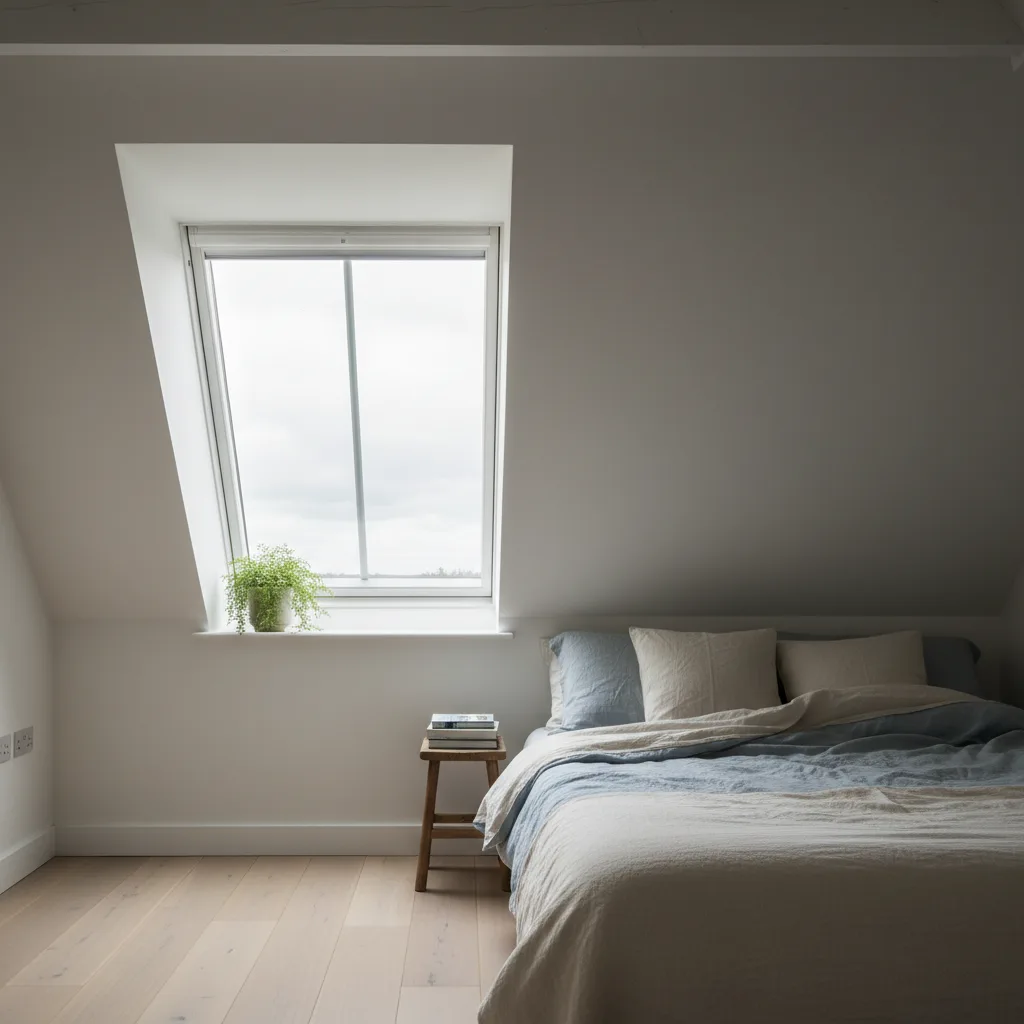
A low emissivity coating on surface 3 does most of the work: it reflects long wave heat back into the room. Argon in the cavity is worth roughly 0.2 W/m²K over air and costs very little. Together they take a unit from about 2.7 down to about 1.1.
Be careful comparing figures. Suppliers quote either the centre pane U-value, which is the glass alone and always flattering, or the whole unit figure, which includes the frame and spacer and is the honest one. A lantern with a great deal of bar has a whole unit figure meaningfully worse than its glass.
Body-tinted glass, and why we rarely use it
Body tinting means the colour is in the glass itself, from metal oxides added at the float stage, rather than in a coating. Bronze, grey and green tints work by absorbing energy rather than reflecting it.
The problem is where the absorbed energy goes. Tinted glass gets genuinely hot, and roughly half of what it absorbs re-radiates inward. So a body-tinted unit cuts daylight sharply while cutting heat only moderately, which is the wrong side of every trade.
Tinted glass also ages the light in the room. A bronze tint gives everything under it a permanent late-afternoon cast, which is pleasant for a fortnight and wearing thereafter. Coated units are the better technology in almost every case.
How a coated unit reads from inside
Modern solar control coatings are described as neutral, but none is perfectly colourless.
The neutral coatings read very slightly grey. The higher performance ones read faintly blue, most noticeably against a white cloud edge or when you look at the glass at a shallow angle from across the room. From outside they can show a subtle reflective sheen in low sun.
Ask the supplier for a sample offcut and hold it up against the sky, not against a desk. That is the only way to know whether the cast bothers you, and it takes a week to arrange and no money.
The inner pane must be laminated
This is not optional and it is not an upsell. Glass fitted overhead must be laminated on the inner leaf so that if it ever breaks, the interlayer holds the fragments in place rather than dropping them onto the floor below.
A 6.4mm laminate is two 3mm sheets bonded to a 0.4mm PVB interlayer. An 8.8mm laminate uses 4mm sheets and a thicker interlayer, and is used on larger facets or where acoustic performance is wanted.
If a quotation for a lantern shows toughened glass on both leaves, question it. Toughened glass fails into small blunt granules, which is safer than shards, but on a roof those granules still arrive on the floor.
The outer pane, toughening and heat soaking
The outer pane is toughened because it takes hail, thermal shock, foot traffic during cleaning and the occasional branch.
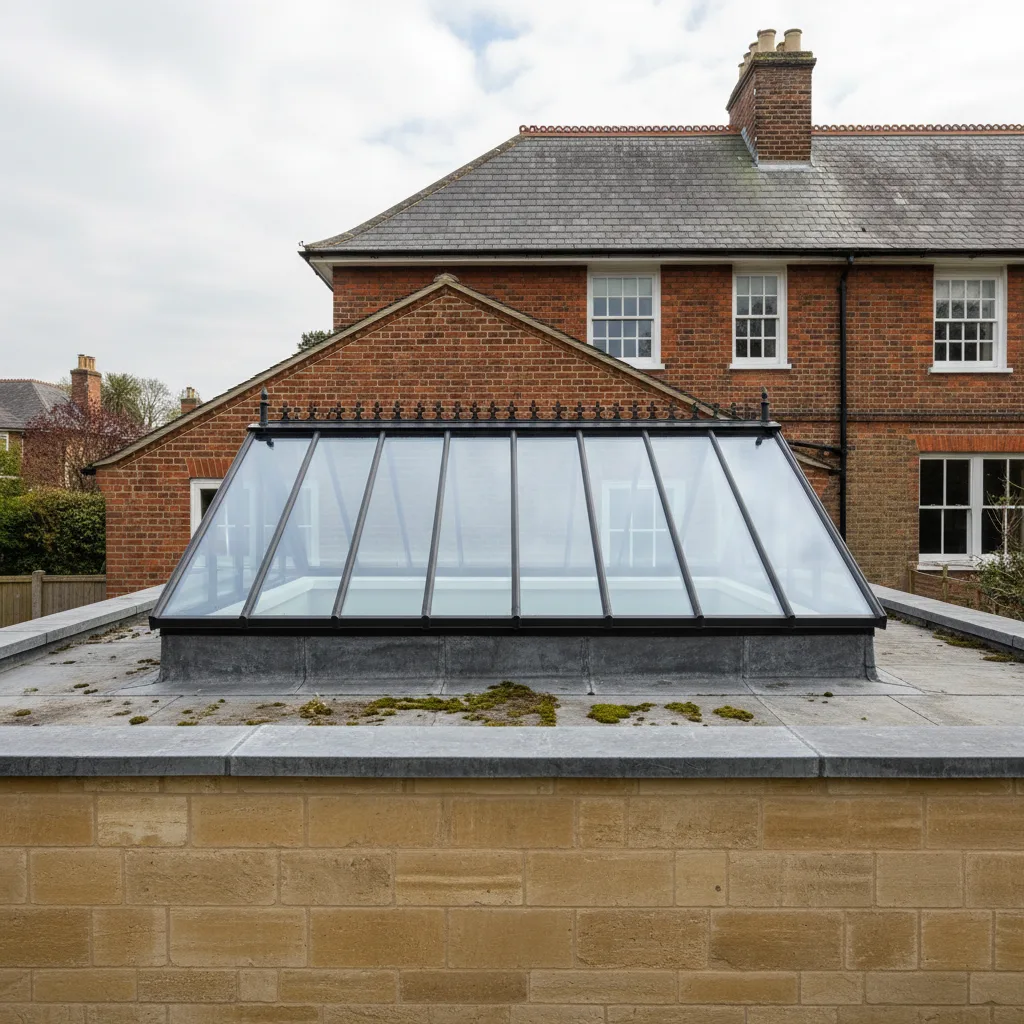
Toughened glass carries a rare defect called nickel sulphide inclusion, a microscopic impurity that can expand years later and shatter the pane with no impact at all. The failure rate is very low, but on a lantern four metres above a kitchen table the consequence is unpleasant.
Heat soaked toughened glass is put through a controlled oven cycle after toughening, which provokes the inclusions into failing at the factory rather than over your dining table. It adds a modest amount to the price and is worth specifying on any large facet.
Warm edge spacers and the cold line at the perimeter
The spacer bar is the strip holding the two panes apart. Traditionally it was aluminium, which conducts heat straight around the edge of the unit and creates a cold band 20mm wide all the way round every pane.
A warm edge spacer replaces the metal with a structural polymer or a thin stainless composite. It improves the whole unit U-value by roughly 0.1 W/m²K and, more usefully, raises the temperature of the glass edge by two or three degrees.
That is where condensation appears first. On a cold morning you see a fine line of moisture around the perimeter of each pane before anywhere else, and a warm edge spacer moves the point at which that starts. Specify one by name: it is a cheap line item that shows up every winter.
Argon, krypton and the case against triple glazing
Argon fill is standard and should be assumed. Krypton performs better in narrow cavities but costs a great deal more and only earns its money where the cavity has to be under 12mm, which is rarely the case in a lantern.
Triple glazing in a roof lantern is usually the wrong answer. It adds a third pane and a second cavity, taking the unit to 44mm or more, which means heavier glass, deeper bars, a bulkier frame and a smaller view of sky. It also drops light transmittance by another chunk.
The gain is perhaps 0.4 W/m²K on a surface that is a modest share of the room’s total envelope. Spend the same money on better solar control and a properly insulated kerb and you will feel more difference.
Self-cleaning coatings, and why they work better on a lantern
A self-cleaning coating is a thin titanium dioxide layer on surface 1. Daylight breaks down organic dirt on the surface, and rain then sheets across the glass rather than beading, carrying the loosened dirt off.
It needs two things to work: ultraviolet light and running water. A pitched lantern facet gives it both, which is why the coating performs noticeably better here than on near-flat glazing where water sits still.
It is not a substitute for cleaning. It extends the interval and stops the streaking that otherwise develops on glass nobody can reach. On a lantern with no safe access, it earns its cost within a couple of years. Access generally is covered on how do you clean a roof lantern.
Acoustic interlayers and the sound of rain
A standard PVB interlayer already dampens rain noise considerably compared with a single sheet of glass. An acoustic interlayer is a softer, denser PVB that damps a wider band of frequencies and is worth about 3 to 5 decibels on the inner pane.

It costs relatively little and it is one of the few glazing upgrades that people notice immediately. Where a lantern sits over a bedroom or a room used for work, specify it.
Rain noise on lanterns generally, including the part played by the frame and the kerb rather than the glass, is covered on are roof lanterns noisy in rain.
A worked specification for a west-facing Oxford kitchen
A rear extension with a 2500mm by 1500mm lantern, west-facing garden, kitchen and dining under one roof, glazed doors across the back. This is the arrangement that overheats, and this is what we would put on the order.
| Element | Specification |
|---|---|
| Outer pane | 6mm toughened, heat soaked, self-cleaning coating on surface 1 |
| Solar control | Neutral coating on surface 2, g-value 0.30 or lower |
| Cavity | 16mm, argon filled, warm edge spacer |
| Low emissivity | Surface 3 |
| Inner pane | 6.4mm laminated with acoustic interlayer |
| Whole unit U-value | 1.2 W/m²K or better |
| Light transmittance | 0.62 or higher |
Glass alone will not fix a room with no way to release hot air. Pair it with opening ventilation at the ridge, which is covered on roof lantern ridge vents and how they are operated.
What to put in writing before you order
Ask for the specification pane by pane, not as a phrase. You want the make-up written as thicknesses and coatings, the whole unit U-value rather than the centre pane figure, the g-value, the light transmittance, confirmation that the inner leaf is laminated on every facet including any vent, confirmation of heat soaking, and the spacer type.
Ask also for the sealed unit guarantee and what it covers. Units fail at the perimeter seal, and the symptom is misting inside the cavity that no cleaning touches. That is a manufacturer matter and separate from our ten year workmanship guarantee, which covers the way the lantern is fitted and the kerb detailing beneath it.
Send us the room dimensions, the aspect and how the space is used and we will put a range in an email. The fixed price follows the survey, once we have seen the roof and confirmed what the glass has to be carried up onto.
Four steps, no surprises
Survey
We look at the roof, the covering and the slope before we say anything about price.
Specification
The right unit and glazing for that roof and that orientation, in plain terms.
Fixed quote
Written, itemised and firm. The number does not move once work starts.
Install
Opening formed, unit set and weathered, covering made good. Notification is ours.
Helpful reading on this
Costs, comparisons and the questions we are asked most.
Tell us about your roof
We start with the building, the covering and the slope. Then we tell you what will suit it, and what it will cost, as a fixed written number.
- Surveyed before it is priced
- 10-year workmanship guarantee
- Building Control notification handled
- New installations and replacements