
A large share of the work we do is taking out a rooflight that has come to the end of its life and putting a new one in its place. This guide covers how to tell what has actually failed, when a replacement is the right answer, what the job involves, and the one thing that turns a straightforward swap into a bigger piece of work.
Work out what has failed before deciding anything
Four different faults present almost identically to somebody standing in the room looking up, and they have four different answers. Getting the diagnosis right is most of the decision.
The sealed unit has failed. Misting between the panes, a permanent haze, sometimes visible droplets trapped inside the glass. The seal around the cavity has gone and the gas fill has been replaced by damp air. The frame may be perfectly sound. This is a glass problem.
The frame has failed. Timber that is soft at the bottom corners, a sash that no longer closes evenly, gaps you can see daylight through, hinges that have dropped. This is a unit problem and it means replacement.
The perimeter has failed. Water appearing at one corner or along one edge, worse in driven rain from a particular direction, absent in ordinary rain. The unit itself is fine and the flashings or laps around it are not. This is an installation problem, and swapping the unit without addressing the perimeter changes nothing.
It is condensing, not leaking. Water running down the reveal in cold weather, worst on winter mornings, dry in summer regardless of rainfall. The build-up around the opening is cold or the vapour control layer is discontinuous. This is a build-up problem and a new rooflight will not touch it.
The pattern of when it happens is the most useful diagnostic available to you, and it costs nothing to observe. Water in cold dry weather is condensation. Water only in wind-driven rain from one direction is a lap. Water in any rain at all is more serious. Haze with no water at all is a sealed unit.
When a glass swap is enough
If the only fault is a misted sealed unit and the frame is genuinely sound, the glass alone can sometimes be changed. On some models the sealed unit is removable and a replacement can be ordered to match.
Whether it is worth doing turns on age. A misted unit in a frame five years old is worth reglazing. A misted unit in a frame twenty-five years old rarely is, because the frame, the hinges, the seals and the flashings are all the same age as the glass and none of them has much life left. Spending on the glass alone buys a few years and then the whole job happens anyway, with the access paid for twice.
There is also a performance argument. A rooflight from the 1990s, even reglazed, is thermally poor by current standards. A modern replacement with a low-emissivity coating, argon fill and a warm-edge spacer is in a different class, and in a room anybody occupies the difference is felt rather than merely calculated.
Why old units fail when they do
Rooflights lead harder lives than windows. They face the sky directly, so they take the full weight of rain, the full temperature swing between a frosty night and a sunny morning, and considerably more ultraviolet than a vertical pane.
Sealed units typically last somewhere between fifteen and twenty-five years before the perimeter seal gives up. Timber frames last longer where they have been recoated on schedule and much less where they have not. Moving parts, hinges, catches and friction stays, wear out on their own timetable and are usually the first thing to annoy anybody.
Which is why a great many Oxfordshire houses are reaching this point at once. Rooflights fitted during the loft conversion boom of the late 1990s and early 2000s are now at exactly the age where sealed units fail, and a good share of our replacement work is that cohort coming due.
What the job actually involves
People assume a replacement is quick because the opening already exists. Part of that is true and part of it is not.
What you genuinely save is the structural work. No rafters are being cut, no trimmers installed, no engineer involved. On a like-for-like swap that is a real saving and it is why replacements are usually cheaper than new openings.
What you do not save is the perimeter, which is where most of the skilled hours were in the first place. The covering around the opening is lifted, the old flashings come out, the new unit is bedded and fixed, and the whole perimeter is detailed again from scratch: underlay dressed in, apron at the bottom, soakers and side flashings worked into the courses, head flashing tucked under the covering above. That work is the same whether the opening is new or forty years old.
You also do not save on access, which costs what it costs, or on making good inside, which is often worse on a replacement because the old reveal has to be brought back to a clean line and the new frame is rarely the exact dimension of the old one.
The thing that changes the job
When the old unit comes out, the timber around the opening is exposed for the first time in decades, and what is found there decides whether this is a morning’s work or something larger.

If water has been getting past the old unit for several winters, the trimmers and the rafter ends around the opening may be soft. Sometimes it is a surface issue and sometimes it runs back into sound timber some distance away. It cannot be seen until the unit is out, and no survey, however careful, can rule it out with certainty.
What you can insist on is that this is dealt with honestly in the quotation before anybody starts. A replacement quotation should say what happens if the opening is found to be in poor condition, how that will be reported to you, and what the cost of putting it right would be. Ours does. A quotation that is silent on it has moved the risk onto you and will produce a difficult conversation at the least convenient moment, with your roof open.
Timber that is not sound cannot carry a new unit. Fitting into it anyway produces a rooflight that is fixed to something rotten, and it will move, and the perimeter will open up.
Matching the size, and why it rarely matches exactly
Standard rooflight sizes have changed over the decades, and manufacturers have revised their ranges. A unit fitted in 1998 often has no exact modern equivalent.
Where the modern unit is slightly smaller, the opening is packed out and the reveal adjusted, which is straightforward. Where it is slightly larger, the opening has to be enlarged, and that is structural work again, which is the point at which a replacement stops being a simple swap.
Some manufacturers make replacement units designed to fit the openings left by their own older models, which removes the problem entirely where the original was theirs. It is worth establishing what is actually up there before assuming either way. The data plate, usually on the sash edge, gives the manufacturer, the model and the size code, and a photograph of it answers the question in a minute.
Doing several at once
If a house has three rooflights of the same age and one has failed, the other two are close behind.
Replacing all three together is meaningfully cheaper per unit than replacing them one at a time over five years, because the access is up once, the covering is disturbed once, and the labour is continuous rather than three separate visits with three sets of setting up. On a scaffolded job the saving is substantial.
It also means the roof matches, which sounds cosmetic and is not entirely. Three units of the same model, age and finish weather at the same rate and are guaranteed from the same date.
Permission on a replacement
Straightforward in most cases and worth checking in a few.

A like-for-like replacement in the same opening on an undesignated house is not development and needs no planning application. It is, however, notifiable under Building Regulations, because it is a controlled fitting with a thermal standard to meet, and the current standard for a replacement rooflight is a whole-unit U-value at or below 2.2 W/m²K.
On a listed building, replacing a rooflight is an alteration and consent is engaged, including on a rear slope nobody can see. On a conservation area house the position depends on the designation and on whether the slope faces a highway.
Where the existing unit is larger than permitted development would now allow, having been fitted before the current rules, replacing like for like is generally acceptable while enlarging it is not.
Upgrading while the roof is open
A replacement puts you in an unusual position: the covering is lifted, the reveal is coming off, and the room is already disrupted. Several improvements that would be disproportionate on their own are close to free at that moment.
Insulating the reveal properly, if the original never was, which most from that era were not. Sealing the vapour control layer to the new frame, continuously. Splaying a reveal that was boxed square, which changes the light in the room more than the new glass will. Running an electrical supply for a future blind or an electric opening, while the ceiling is open. Adding solar control glazing on a south or west slope, if the room has always been too hot in summer and nobody connected that to the rooflight.
Ask for these to be priced as options on the quotation rather than deciding on the day. They are cheap now and expensive later, and the later version involves opening the same roof twice.
How long it takes, and what happens to the room
A straightforward like-for-like replacement in a tiled pitched roof is usually a single working day: the old unit out in the morning, the new one in and weathered by early afternoon, making good inside to follow.
The roof is never left open overnight. If something is found that stops the job, the opening is made weathertight before anybody leaves, and that is a firm rule rather than an intention. Weather is the usual reason a date moves, and we would rather move a date than open a roof we cannot close.
Inside, expect dust. The room below is sheeted and the floor protected, but taking out an old frame and its plaster is a dirty operation and the honest advice is to move anything you care about out of the room rather than trusting a dust sheet.
Making good is usually a day or two behind the roof work, because plaster needs to dry before it is decorated. Whether decoration is included is something to settle in the quotation rather than assume.
What we do and do not take on
We take out failed units and install new ones, and we detail the perimeter properly while we are there. That is a replacement installation and it is core to what we do.
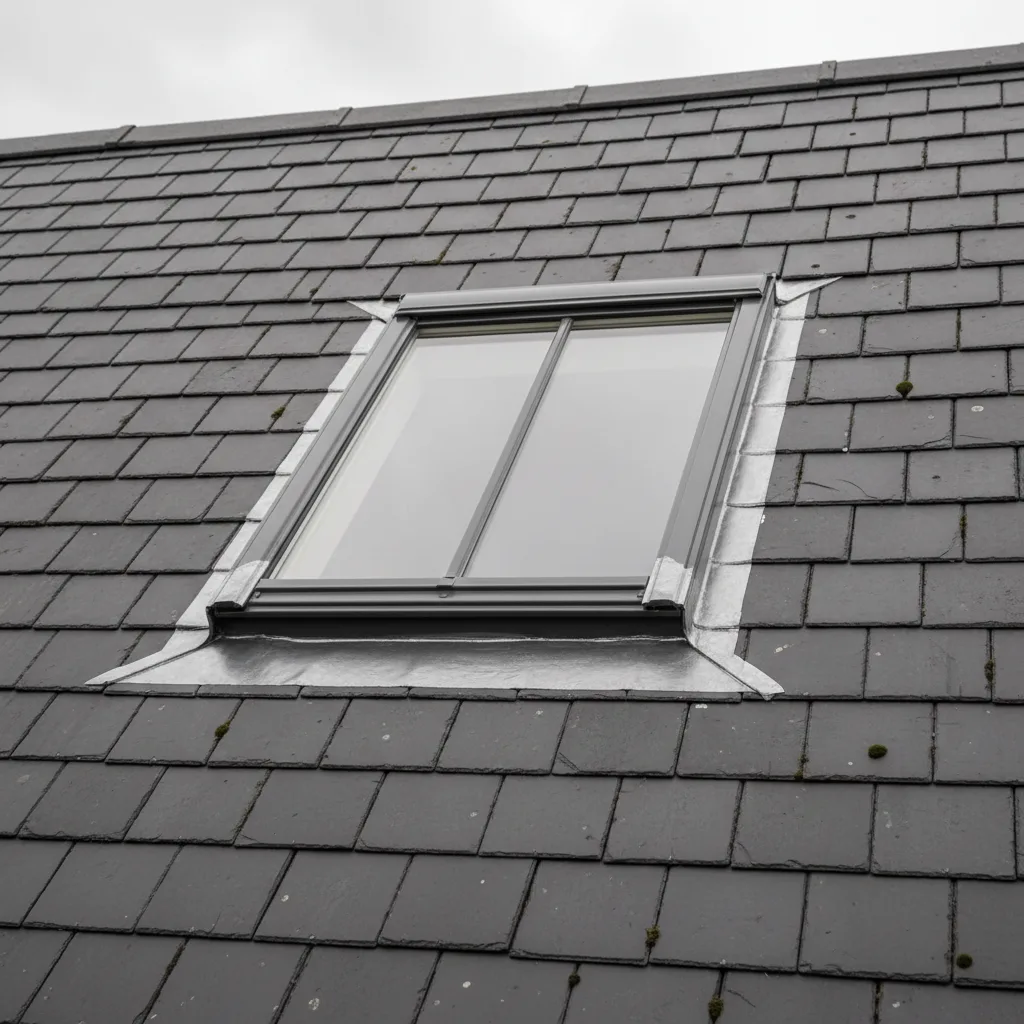
What we do not do is remedial roofing. Where a survey shows the covering around the opening has become brittle, or the roof more widely is at the end of its life, fitting a new rooflight into it would be putting a good unit into a poor host. We will say so and decline, and we would rather do that than take the work.
Where the diagnosis turns out to be condensation rather than a failed unit, we will tell you that too, and what would actually fix it. It is a shorter conversation than selling you a rooflight you do not need, and it is the one worth having.
Four steps, no surprises
Survey
We look at the roof, the covering and the slope before we say anything about price.
Specification
The right unit and glazing for that roof and that orientation, in plain terms.
Fixed quote
Written, itemised and firm. The number does not move once work starts.
Install
Opening formed, unit set and weathered, covering made good. Notification is ours.
Helpful reading on this
Costs, comparisons and the questions we are asked most.
Tell us about your roof
We start with the building, the covering and the slope. Then we tell you what will suit it, and what it will cost, as a fixed written number.
- Surveyed before it is priced
- 10-year workmanship guarantee
- Building Control notification handled
- New installations and replacements