
Two invisible things inside a sealed unit do most of the thermal work: a metallic coating a few atoms thick on one of the cavity faces, and a heavy inert gas filling the gap. Between them they take a rooflight from a U-value near 2.8 to one near 1.2 without changing the thickness, the weight or the appearance. Neither is exotic and neither costs much. What varies between suppliers is which coating, which face it sits on, how much gas is actually in the cavity, and whether anyone will put those answers in writing.
Emissivity, and what a low number means for glass
Every surface radiates heat in proportion to its temperature and its emissivity, a figure between 0 and 1. Uncoated glass has an emissivity around 0.89, which makes it an excellent radiator. A warm room heats the inner pane, and that pane cheerfully radiates its heat across the cavity to the cold outer pane, which sends it outside.
A low-emissivity coating drops the surface figure to somewhere between 0.03 and 0.17 depending on the type. The coated face stops radiating effectively, so the radiant component of heat transfer across the cavity nearly disappears. Only conduction and convection through the gas remain, and that is what the argon is for.
The scale of it is easy to underestimate. Radiation accounts for roughly two thirds of the heat crossing an uncoated cavity. Removing most of that single mechanism is why a coated unit outperforms an uncoated one by so much more than the price difference suggests.
Hard coat and soft coat
Two manufacturing routes exist and they are not interchangeable.
Hard coat, also called pyrolytic, is applied to the glass while it is still hot on the float line, so the tin oxide layer fuses into the surface. It is durable, it can be handled and stored like ordinary glass, it can be toughened afterwards, and it can be used as a single-glazed surface. Its emissivity is around 0.15 to 0.17, which is good rather than excellent, and it carries a faint warm tint.
Soft coat, or sputtered, is applied in a vacuum chamber after the glass has cooled, building up multiple layers including a silver film. Emissivity reaches 0.03 to 0.05. It is far more effective and far more fragile: the layer oxidises in air, so it must face into a sealed cavity and the glass edge has to be deleted back before the seal is applied.
Anything worth buying for a rooflight is soft coat. Hard coat appears in single-glazed conservation applications and in some polycarbonate-adjacent products, and where you see it quoted for a sealed unit it is usually a cost decision.
Which cavity face the coating sits on
Glass surfaces are numbered from outside inward. In a double-glazed unit, surface 1 is the outer face of the outer pane, surface 2 is the cavity face of the outer pane, surface 3 is the cavity face of the inner pane, and surface 4 is the room face.
A thermal low-emissivity coating for a British climate belongs on surface 3. From there it reflects long-wave heat from the room back into the room and keeps the inner pane warm.
A solar control coating belongs on surface 2, where it intercepts solar energy before it has entered the cavity and can re-radiate it outward. Put a solar control coating on surface 3 and you have absorbed the heat into the unit first, which raises the inner pane temperature in summer and defeats the purpose.
| Surface | Position | What belongs there |
|---|---|---|
| 1 | Outer face, exposed to weather | Self-cleaning coating, if specified |
| 2 | Cavity face of the outer pane | Solar control coating |
| 3 | Cavity face of the inner pane | Thermal low-emissivity coating |
| 4 | Room face | Nothing on a rooflight; anti-reflective in specialist cases |
What a coating costs you in daylight
Nothing is free. A single soft coat on a double-glazed unit takes light transmittance from roughly 80 per cent down to 75 to 78. That is imperceptible.
The visible effect people do notice is not brightness but tone. Early soft coats had a distinct green or blue cast, and cheap ones still do. Modern neutral coatings hold a colour rendering index above 95, meaning the daylight arriving through them reflects colours in the room close to how they look outdoors.
That matters more on a rooflight than on a window, because a rooflight is often the main daylight source in the room beneath and there is no uncoated aperture nearby to correct your impression. In a kitchen or a studio, ask for the light transmittance figure and the colour rendering index, and ask to see a sample against the sky rather than flat on a bench.
Solar control coatings and where they differ
A solar control coating uses additional silver layers tuned to reflect near-infrared while passing as much visible light as possible. The ratio between those two is the selectivity, and it is the number that separates a good product from a tinted one.
A well-selected solar control glass might transmit 60 per cent of visible light while admitting only 33 per cent of total solar energy. A poor one transmits 45 per cent of light and 40 per cent of energy, meaning you have paid in daylight for very little heat control.
Divide the light transmittance by the g-value. Above about 1.7 is a genuinely selective product. Around 1.2 is essentially tinted glass. This is one number a supplier will rarely volunteer and can always calculate.
Argon, and what filling the cavity buys
Argon conducts heat at about 0.017 W/mK against air at 0.024, and it is denser, so convection currents inside the cavity are slower to form and weaker when they do.

The practical result on a coated 16mm cavity is an improvement of roughly 0.2 to 0.3 W/m²K in the centre-pane figure over the same unit filled with air. It costs almost nothing at manufacture because the filling step is part of the line.
Argon and the low-emissivity coating work as a pair rather than independently. Argon in an uncoated cavity helps a little, because radiation still dominates and the gas cannot address it. A coating in an air-filled cavity helps a great deal, and adding argon then removes most of what is left. Specify both or you have half a unit.
Cavity width and the point where argon stops helping
There is an optimum and it is narrower than people assume.
Below about 12mm, the panes are close enough that conduction across the gas dominates and performance falls off sharply. Between 14mm and 18mm, argon performs at its best. Above about 20mm, the gas has enough room to set up a convection loop, rising against the warm pane and falling against the cold one, and it starts carrying heat across the gap it was meant to block.
Sixteen millimetres is the usual answer for argon. Krypton peaks nearer 10 to 12mm because it is denser and needs less room to suppress convection, which is precisely why it appears in slim units.
On a rooflight there is an additional wrinkle. The cavity is inclined rather than vertical, and convection in an inclined cavity behaves differently from convection in an upright one. Performance in a shallow-pitched unit is marginally worse than the same unit tested vertically, which is one reason the test standard specifies a vertical orientation and one reason the installed reality lags the published figure.
Krypton and xenon, and the narrow case for them
Krypton conducts at roughly 0.0094 W/mK, a little over half of argon. Xenon is better again at 0.0055. Both are far more expensive because both are extracted in tiny quantities from air separation.
The case for krypton is geometric rather than thermal. In a slim conservation-grade unit where the frame cannot take a 16mm cavity, a 10mm krypton cavity performs about as well as a 16mm argon one. You are buying back the performance the appearance constraint took away.
In a standard frame with room for a proper cavity, krypton buys perhaps 0.1 W/m²K for a substantial price increase, and the gas leaks out at the same rate argon does. Xenon is a laboratory answer to a domestic question. Neither is worth pursuing unless the frame depth has forced your hand.
Fill rates, and the gas that quietly leaves
A unit is not filled to 100 per cent. Manufacturing standards generally require at least 90 per cent argon at production, and good lines achieve 92 to 95.
The gas then leaks. Permitted loss rates are around 1 per cent of the fill per year, so a well-made unit still holds a useful concentration after fifteen years. A badly made one, with a poorly formed primary seal or corner joints that were never properly closed, can be down to air within five.
You cannot see this happening. A unit losing argon looks identical to one holding it, right up until the desiccant saturates and the cavity mists. The performance decline, meanwhile, has been quietly under way for years with no symptom at all.
Whether a unit still holds its gas
There is a test and it does not involve breaking the unit. A spark emission meter fires a small discharge across the cavity and reads the emission spectrum, which tells you the argon concentration to within a few per cent.

It is not a domestic service and it is rarely worth commissioning on a house. It is worth knowing it exists, because it is the reason a manufacturer can make a defensible statement about fill rate and a merchant selling unbranded units usually cannot.
The practical domestic proxy is age and provenance. A unit from a named manufacturer with a published guarantee and a legible edge stamp is very likely to be holding its fill. An unbranded unit of unknown age is a coin toss, and the way you find out is that it eventually mists.
Coatings on the outer face
Surface 1 is exposed to weather, so anything applied there has to survive rain, frost and cleaning.
Self-cleaning glass carries a pyrolytic titanium dioxide layer. Ultraviolet light triggers a reaction that breaks down organic dirt, and the surface is hydrophilic, so rain sheets across it rather than beading and carries the loosened dirt away. On a rooflight, which nobody wants to clean at height, this earns its modest cost more convincingly than it does on a ground-floor window.
It has limits worth stating plainly. It needs direct rain to work, so a unit sheltered under a large overhang or under a tree gets very little benefit. It needs ultraviolet light, so it works poorly on a permanently shaded north slope. And it does nothing about mineral deposits from hard water, which is the deposit most likely to mark an Oxfordshire rooflight.
Two coatings and two cavities in a triple unit
A triple-glazed unit normally carries low-emissivity coatings on surfaces 2 and 5, or on 3 and 5, depending on whether solar control is wanted.
Both cavities are filled, and both are subject to the same width optimum. This is where slim triple units come unstuck: two cavities at 10mm each with argon perform considerably worse than one cavity at 16mm plus one at 16mm, and the published unit figure will show it.
The middle pane also has to be thin enough to keep the weight down, which limits what can be laminated where. Where the inner pane must be laminated for overhead safety, that constrains the build-up further.
What a coating does to the surface you touch
The inner pane of a coated argon-filled unit runs several degrees warmer than the inner pane of an uncoated air-filled one at the same outside temperature. With zero outside and twenty inside, an uncoated double sits near 11 degrees and a coated argon-filled one near 15.
That is above the dew point of a normally occupied living room and below the dew point of a poorly ventilated kitchen. It is the difference between a rooflight that stays clear and one that mists most winter mornings, and it is achieved by two things you cannot see.
The edge of the glass sits colder than the centre regardless, which is a separate component decision covered on warm-edge spacers and where condensation starts.
The reflection you see from the garden
Low-emissivity coatings raise the external reflectance of the glass slightly, and solar control coatings raise it a good deal more.
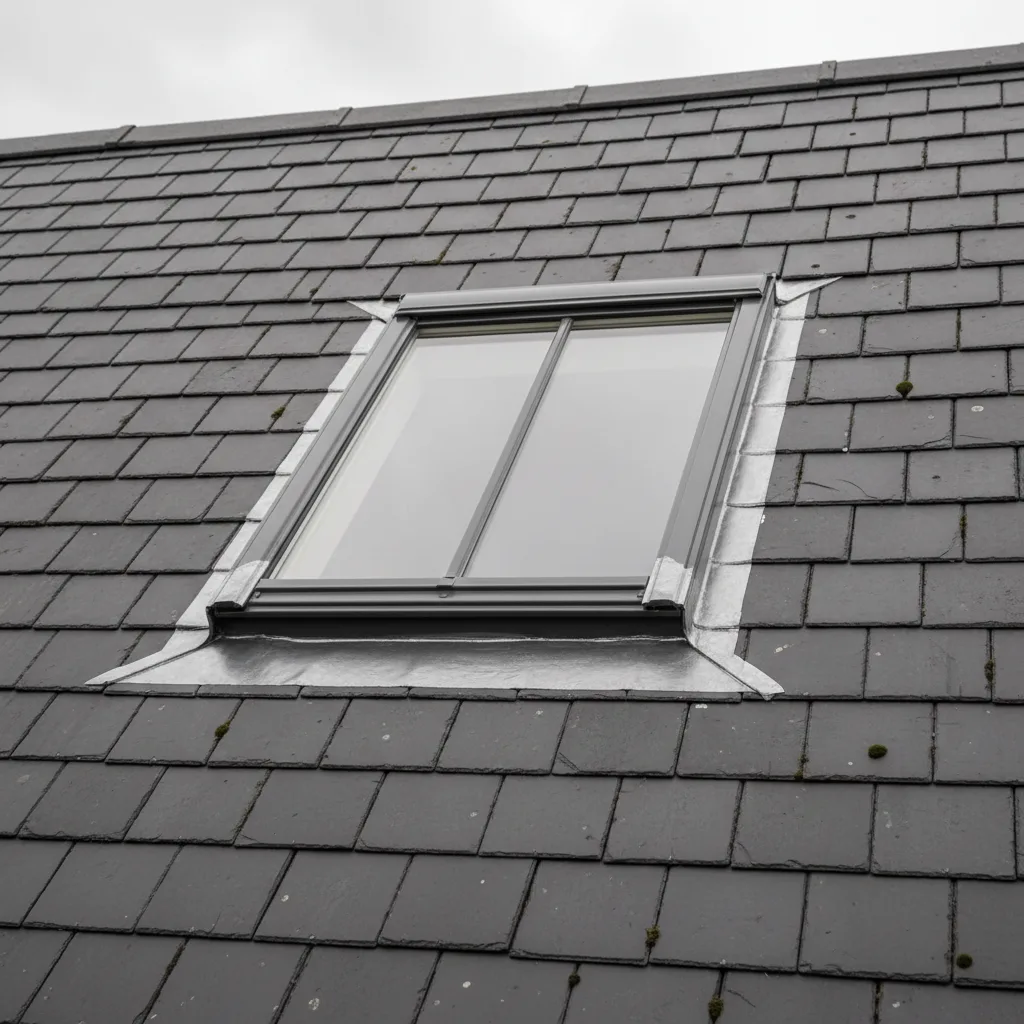
From the ground, a solar control rooflight on a visible slope can read as a mirror on a bright day, showing sky rather than the dark void a plain unit shows. On a conservation slope or a front elevation subject to planning conditions, that appearance is occasionally an issue in itself.
Neutral solar control products exist specifically to address this, at some cost in selectivity. If the roof is visible from a street or from a neighbour’s window, ask what the external reflectance figure is and ask to see the product on an existing roof rather than as a sample.
Putting it on the order
Six lines cover it, and any manufacturer publishes all six.
- Coating type and product name, with hard or soft coat stated.
- The surface number the coating occupies.
- Cavity width in millimetres, per cavity.
- Gas type and the fill percentage at manufacture.
- Light transmittance and g-value, so you can calculate the selectivity yourself.
- External reflectance, if the roof is visible.
A quotation reading “low-e argon” has told you the two things that are true of nearly every unit sold and none of the things that separate one from another.
What the coatings cannot compensate for
Glass technology addresses heat crossing the glass. It has nothing to say about heat leaving around the frame, through an uninsulated reveal, or through a gap where the insulation stopped 40mm short of the timber.
On a small rooflight those perimeter losses can exceed the losses through the glass entirely, and no coating specification will touch them. That is why we treat the glazing schedule and the perimeter detail as one conversation, described on thermal bridging at the rooflight perimeter.
Send the sizes, the slope orientations and what each room is used for to info@heritageskylightsoxford.co.uk, or call 01865 704245, and we will come back with a range and a specification we can defend line by line before anybody visits.
Four steps, no surprises
Survey
We look at the roof, the covering and the slope before we say anything about price.
Specification
The right unit and glazing for that roof and that orientation, in plain terms.
Fixed quote
Written, itemised and firm. The number does not move once work starts.
Install
Opening formed, unit set and weathered, covering made good. Notification is ours.
Helpful reading on this
Costs, comparisons and the questions we are asked most.
Tell us about your roof
We start with the building, the covering and the slope. Then we tell you what will suit it, and what it will cost, as a fixed written number.
- Surveyed before it is priced
- 10-year workmanship guarantee
- Building Control notification handled
- New installations and replacements