
Condensation on a rooflight almost always begins in the same place: a band 15 to 30mm wide running around the inside edge of the glass, where the spacer bar sits between the panes. That band is the coldest glass in the unit, it is colder than the centre by several degrees, and on a still night in January it is the first surface in the room to fall below dew point. The spacer is a strip of material most people never think about and it decides how cold that band gets. This page explains what the strip does, what the materials are, and why the edge wets before anything else.
What the strip between the panes is doing
The spacer holds the panes apart at a fixed distance, and that is the least of its jobs.
It also carries the desiccant that keeps the cavity dry, it forms the inner wall of the sealed cavity that retains the argon, it provides the bonding surface for the two seals that make the unit gas-tight, and it takes the structural load when the panes flex under wind or pressure change. A sealed unit is not two sheets of glass with a gap. It is a manufactured component whose edge is the engineered part, and whose middle is just glass.
Because the spacer bridges from the cold outer pane to the warm inner one, it is also a heat path straight through the insulating cavity. What it is made of therefore governs how much heat runs around the edge of the glass and how cold the inner face gets there.
Aluminium spacers and the cold line they draw
Aluminium conducts heat at roughly 160 watts per metre kelvin. Glass manages about 1. Argon in a cavity is around 0.017.
So a hollow aluminium bar bridging a 16mm cavity short-circuits the entire insulating gap at its perimeter. Heat leaves the inner pane, runs through the metal, and exits through the outer pane, and the inner glass immediately above the bar drops to within a couple of degrees of the outer face.
Units made before roughly the mid-2000s are nearly all aluminium-spaced, and you can identify them from below: the silver line visible between the panes at the edge is the bar itself. If your rooflight mists in a band around its border every cold morning and stays clear in the middle, you are looking at an aluminium spacer doing what aluminium does.
What “warm edge” actually describes
The term is not a brand and it is not a marketing category, though it gets used as one. It describes any spacer whose material and geometry keep the thermal conductivity of the edge assembly low enough that the inner glass at the perimeter stays significantly warmer than an aluminium equivalent would deliver.
Two things achieve it. The first is a low-conductivity body: plastic, foam, or a metal so thin it carries almost nothing. The second is geometry, meaning the path heat has to take is made long and narrow rather than short and fat.
The performance difference between one warm-edge product and another is real but small compared with the gap between any of them and aluminium. The important decision is aluminium or not. The choice among the alternatives is a refinement.
The materials compared
Four families cover almost everything on the market.
| Type | Construction | Relative edge conductivity | Notes |
|---|---|---|---|
| Aluminium box | Hollow rolled aluminium bar | Worst by a wide margin | Standard until the 2000s; still found in cheap imported units |
| Stainless steel | Thin-wall rolled steel, often 0.12mm | Moderate | Steel conducts far less than aluminium and the wall is very thin; rigid and durable |
| Thermoplastic | Extruded polymer applied as a hot bead with an integral vapour barrier | Good | Applied in one continuous run, so there are no corner joints |
| Structural foam or composite | Silicone or polymer foam with a thin metal vapour foil | Best | Lowest conductivity available; the foil handles gas retention |
Any of the bottom three is a legitimate specification. All that matters is that the quotation names one of them rather than staying silent, because silence usually means aluminium.
Psi values, and the heat that leaves along a line
A U-value describes heat loss through an area. The edge of a glazed unit loses heat along a line, and that is measured separately as a linear thermal transmittance, written with the Greek letter psi and expressed in W/mK.
An aluminium-spaced edge typically sits around 0.08 W/mK. A good warm-edge product sits around 0.03 to 0.04. The difference sounds trivial until you work out how much edge a rooflight has.
A 780mm by 1400mm unit has 4.36 metres of perimeter. At 0.05 W/mK of difference, that is 0.22 watts per degree, which is a comparable order of magnitude to the entire benefit of adding a third pane to the same unit. The edge is not a detail. On small units it is one of the largest single items in the heat loss calculation, and it costs a fraction of what glass upgrades cost.
Why a rooflight edge behaves worse than a window edge
The same spacer performs worse in a roof than in a wall, for three reasons that compound.

First, the glass faces the sky. On a clear night the outer pane radiates to an effective sky temperature well below the air temperature, so it can sit several degrees colder than a vertical window on the same building. Everything conducted through the spacer arrives at a colder destination.
Second, warm moist air rises. The most humid air in any room ends up at ceiling level, in direct contact with the coldest surface in the room.
Third, gravity is on the wrong side. Moisture forming on the edge of a vertical window runs down the pane to a drainage channel designed for it. Moisture forming on a sloped rooflight runs down to the bottom edge and pools against the frame, or on a shallow pitch simply sits there.
Dew point, and the order in which surfaces wet
Air holds a finite quantity of water vapour at a given temperature. Cool it and it reaches saturation, and below that point the excess condenses onto whatever surface caused the cooling.
A living room at 20 degrees and 55 per cent relative humidity has a dew point of about 10.7 degrees. A kitchen at 20 degrees and 70 per cent has a dew point of 14.4. In a bathroom immediately after a shower, the dew point can be above 18.
Set those against surface temperatures on a night with zero degrees outside. The centre of a warm-edge double-glazed rooflight sits near 15 degrees. The edge over a warm-edge spacer might be 12. The edge over an aluminium spacer might be 7. The living room wets only on the aluminium edge. The kitchen wets on both edges but not in the centre. The bathroom wets everywhere, and no spacer on earth will change that: see what causes condensation on a rooflight.
The desiccant, and what it is protecting
Inside a hollow spacer, or bonded into a foam one, sits a moisture-absorbing granulate, usually a molecular sieve. Its job is to take up the small quantity of water vapour trapped in the cavity at manufacture and any tiny amount that migrates through the seals over the years.
Without it, cavity air would condense on the inside of the panes on the first cold night, and you would be looking at misting you cannot wipe. With it, the cavity dew point is driven down to around minus 40 degrees and stays there for as long as the seals hold.
The desiccant has a finite capacity. When misting appears between the panes rather than on the room face, the desiccant has been saturated, which means the seal has been admitting moist air for some time. That unit has reached the end of its service life and gets replaced with a new one.
Primary and secondary seals
The edge is sealed twice, and the two seals do different work.
The primary seal is a thin bead of polyisobutylene between the spacer and each pane. It is the gas barrier: it is what keeps argon in and water vapour out. It has almost no structural strength.
The secondary seal fills the channel outboard of the spacer, usually with polysulphide, polyurethane or silicone. It is the structural bond holding the two panes to each other, and it takes the wind load and the thermal movement.
On a rooflight, the secondary seal choice matters more than it does in a wall because the edge is exposed to ultraviolet light from a high sun for far more of the day. Units for overhead use should carry a silicone secondary seal, which is ultraviolet stable. Polysulphide degrades under sustained ultraviolet exposure and that is one of the reasons a cheap unit fails early in a roof when the identical unit lasts in a window.
What a failing edge looks like from below
Four signs, in the order they usually appear.

- A faint haze between the panes on cold mornings that clears by mid-morning and cannot be wiped from either face.
- The haze persisting later into the day and covering more of the pane over successive winters.
- Fine droplets or a permanent bloom in the cavity that never clears.
- Visible staining or a tide line inside the cavity, sometimes with the low-emissivity coating showing degradation as a mottled unevenness at the edge.
None of that is condensation in the room and none of it is a fault in the installation. It is a sealed unit at the end of its life, and the answer is a new unit or a new rooflight depending on the condition of the frame.
Sightline depth, and the glass you cannot see
The sightline is the distance from the visible edge of the glass to the point where the glass becomes visible cavity, and it is set by how far the spacer sits in from the pane edge plus the depth of the frame rebate covering it.
Deeper spacers and deeper rebates hide more glass. On a large rooflight nobody notices. On a small conservation unit with a slim profile, a 20mm sightline against a 12mm one is a visible difference in how much glass you actually see.
Some manufacturers use the sightline to hide a wider structural seal. That is legitimate engineering, but it is worth knowing that the ordered size and the glazed size are two different numbers, and only one of them lets light through.
Two spacers in a triple unit
A triple-glazed unit has two cavities and therefore two spacer runs, one on each side of the middle pane.
That doubles the edge conduction path, which is why the improvement in the whole-unit U-value from triple glazing is always smaller than the improvement in the centre-pane figure. It also means specifying aluminium in a triple unit wastes a large share of what you paid for. If the middle pane is bridged to both outer panes by metal, the edge becomes a thermal short circuit through a unit you bought for its thermal performance.
Anyone quoting triple glazing should be quoting warm edge as a matter of course. Where they are not, ask why, and consider whether the money is better spent as described on triple glazing in a rooflight and when it pays.
The visible colour of the bar
Spacers come in black, grey, white, mill silver and occasionally a matched frame colour. This is an aesthetic decision with one practical consequence.
Looking up at a rooflight, you are looking at glass against a bright sky. A pale spacer reads as a bright frame within a frame and draws attention to the edge. A black spacer disappears into the shadow line of the frame and the glass looks larger.
Black is the default worth specifying on any rooflight, and it costs nothing extra from most manufacturers. It is a one-word instruction on an order that people forget to give, and it cannot be changed afterwards.
What the spacer will not fix
A warm-edge spacer moves the coldest point of the glass a few degrees. It does not address the coldest point of the opening, which is usually the reveal rather than the glass.
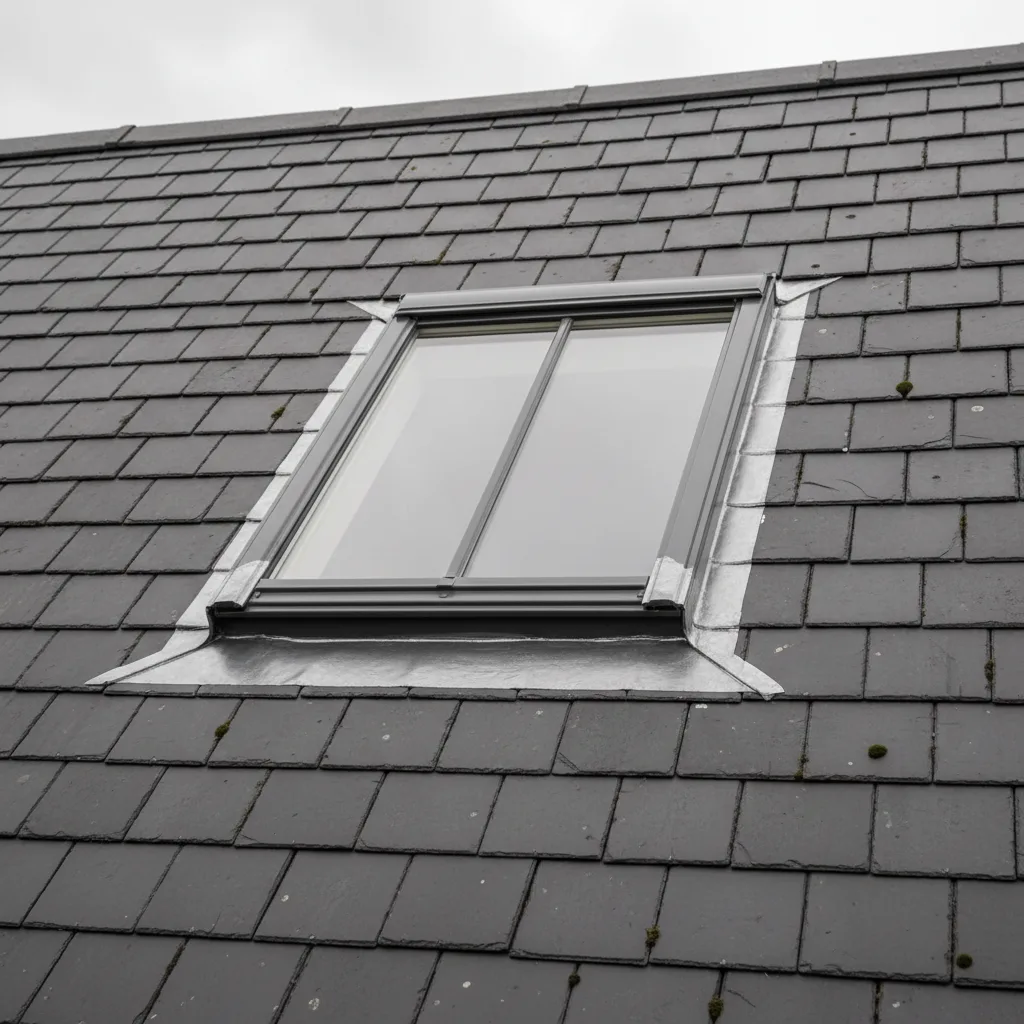
Where insulation stops short of the frame or is compressed into the gap between frame and trimmer, the plasterboard reveal runs colder than any part of the unit and that is where water appears. Owners see it near the glass and conclude the glazing is at fault. It is not, and no spacer specification will change it. That junction is covered on thermal bridging at the rooflight perimeter.
Equally, a spacer cannot lower the moisture load in the room. Drying clothes under a rooflight, a bathroom without working extraction, or an unvented kitchen will defeat any glass specification you care to buy.
Getting it onto the order
Warm edge is a line item, not an assumption. On a quotation it should read as a named type: stainless steel, thermoplastic, or a structural foam composite, along with the spacer colour and the secondary seal material.
If a quotation states a whole-unit U-value and nothing about the edge, the figure already contains a spacer assumption and you cannot tell which one. Ask for the psi value if you want the precise answer, or simply ask what the spacer is made of, which gets you most of the way there.
Why you cannot change it later
The spacer is inside a factory-sealed unit. There is no route to it that does not involve breaking the primary and secondary seals, which destroys the unit.
So this is one of the small set of decisions that are permanent at the point of order. It costs very little at that moment and it costs the price of a new sealed unit at any later moment. That is the whole argument for getting it right on the paperwork.
If you are unsure what is in an existing rooflight, look at the edge of the glass from inside on a bright day. A silver line is aluminium. A black or grey matt line is almost certainly warm edge. Call 01865 704245 or email info@heritageskylightsoxford.co.uk if you want a view on whether the units you have are worth keeping.
Four steps, no surprises
Survey
We look at the roof, the covering and the slope before we say anything about price.
Specification
The right unit and glazing for that roof and that orientation, in plain terms.
Fixed quote
Written, itemised and firm. The number does not move once work starts.
Install
Opening formed, unit set and weathered, covering made good. Notification is ours.
Helpful reading on this
Costs, comparisons and the questions we are asked most.
Tell us about your roof
We start with the building, the covering and the slope. Then we tell you what will suit it, and what it will cost, as a fixed written number.
- Surveyed before it is priced
- 10-year workmanship guarantee
- Building Control notification handled
- New installations and replacements