
External shading stops roughly three times as much heat as an internal blind of the same fabric, and the reason is not the fabric. It is that heat stopped outside the glass is still outside, while heat stopped by an internal blind has already entered the room and is being absorbed by something hanging in it. If overheating is the problem you are solving, the blind belongs on the outside. If darkness, privacy or appearance is the problem, the blind belongs inside. Most rooms want one of each, and knowing which is doing which job saves buying the wrong one twice.
The physics that settles the argument
Solar energy arriving at a rooflight has three possible fates: it is reflected away, it is absorbed by something, or it is transmitted through.
An external blind intercepts the energy before the glass. Some is reflected straight back to sky, and what the fabric absorbs heats the fabric, which sits in moving outdoor air and loses that heat by convection to the wind. Very little of it reaches the room.
An internal blind intercepts energy that has already passed the glass. Some is reflected back out, though it must cross the glazing a second time and a portion is caught on the way. The rest heats the fabric, and that fabric is hanging in still indoor air with a pane of glass above it. It radiates and convects into the room, and the trapped air between blind and glass becomes a hot layer that eventually spills down into the room anyway.
Expressed as a total solar energy transmittance for the assembly, a mid-tone external awning over standard double glazing might give a combined g-value near 0.10. The same fabric inside gives roughly 0.35. The glass alone gives 0.6.
External awning blinds and how they mount
The common form on a pitched roof window is a tensioned mesh awning running in side rails fixed to the outside of the frame, driven by a small motor at the head and rolled into a cassette at the top.
They mount to the rooflight frame itself, not to the roof covering, which is the important detail. Nothing is drilled through the flashing and nothing penetrates the weathering. The side rails clip or screw into channels that manufacturers provide in the outer frame for exactly this purpose.
That is why fitting one at the time of installation is straightforward and fitting one afterwards is sometimes not. If the rooflight is a model with the awning channel built in, retrofitting is a job that takes minutes from a ladder or a scaffold. If it is not, there is no proper fixing available and the alternative involves drilling into a weathered assembly, which we will not do.
Internal blinds and what they are genuinely good at
Internal blinds do three jobs that external shading cannot touch.
They provide blackout. A blackout cassette blind running in side channels with a light-sealing profile is the only way to get a bedroom genuinely dark under a rooflight, and no external mesh will do it because mesh has holes in it by definition.
They provide a controllable interior appearance. The blind is part of the room, in a chosen fabric and colour, and it is visible daily in a way an external awning is not.
They add a small thermal benefit in winter. A closed pleated or honeycomb blind traps a layer of still air against the glass and can improve the effective night-time U-value by a modest amount, which also raises the room-side surface temperature slightly and reduces the downdraught off cold glass.
Solar power, mains power and manual operation
Three ways to drive a blind, and the choice usually decides itself.
Solar-powered external awnings carry a small photovoltaic cell and a rechargeable battery at the head of the cassette. No cable enters the building, so there is no wiring, no penetration and no electrical work. Charging depends on the unit receiving light, which on a south or west slope it certainly does, and those are the slopes that need shading. On a north slope a solar blind is both unnecessary and poorly charged.
Mains-powered units need a cable into the frame, which means a route planned before the rooflight is fitted and finished. Retrofitting cabling into an installed unit means opening the reveal.
Manual operation is workable for internal blinds within reach and for pole-operated blinds up to about three metres. Above that it stops being used, and an unused blind is a blind you paid for and did not get.
Fixing a blind without compromising the weathering
This is the boundary we hold firmly, and it is worth stating clearly because the trade is not consistent about it.
An external blind may be fixed to the manufacturer’s provided channels in the rooflight frame. It may not be fixed through the flashing, through the roof covering, into the slates or tiles, or into the upstand of a flat-roof unit below the covering termination. Every one of those creates a hole in the weathering line and every one of those eventually admits water.
Where a client wants external shading over a unit that has no provision for it, the honest answer is that a freestanding structure over the roof, a pergola, or an awning fixed into masonry above the opening are the routes that do not compromise the roof. Sometimes the honest answer is that external shading is not achievable on that unit and a solar control glass upgrade is the better use of the money.
Wind ratings, and what happens in a gale
An external awning is a sail on a roof, and this is the practical constraint people underestimate.
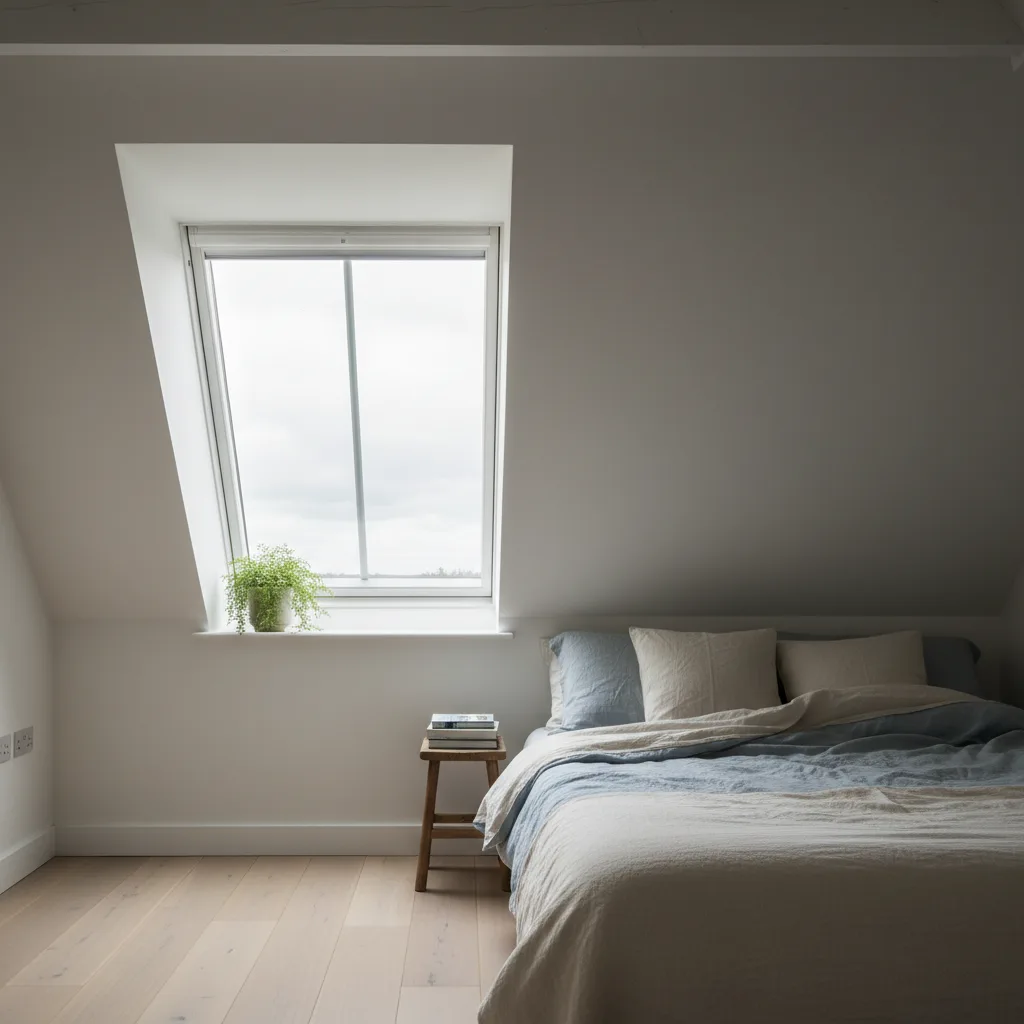
Products carry a wind resistance class, usually stated on a scale from 0 to 3, describing the wind speed at which the manufacturer will stand behind the awning remaining deployed. A class 3 tensioned mesh awning in side rails is good to roughly 50 to 60 km/h. Above that it should be retracted.
Motorised versions can be wired or paired with a wind sensor that retracts them automatically, and on an exposed roof that is not an optional extra. Without it, the awning survives on the occupant remembering, and nobody remembers at two in the morning.
Side rails are the mechanical difference between a product that lasts and one that flogs itself to pieces. An awning that hangs free at its lower edge will not last on a British roof.
Openness factor and the view you keep
External mesh is described by its openness factor, the percentage of the fabric area that is holes.
A 1 to 3 per cent mesh blocks most of the light and most of the view, and reads as a dark screen from inside. A 5 per cent mesh keeps a usable if muted view of sky and blocks the great majority of the solar energy. A 10 per cent mesh keeps a good view and does correspondingly less thermal work.
Fabric tone matters too, and counterintuitively. A pale mesh reflects more energy but scatters more light, so it produces glare and a washed-out view. A dark mesh absorbs more energy, which is acceptable because it is outside in the wind, and gives a much clearer view through with far less glare. For a rooflight, where the view is sky and the problem is glare, dark and around 5 per cent openness is the specification that usually satisfies people.
Blackout is a separate requirement from heat
Conflating the two is the most common ordering error we see.
A bedroom rooflight over a west-facing slope in June has two problems: it is too hot at six in the evening and it is too light at half past four in the morning. External mesh addresses the first entirely and the second not at all. An internal blackout blind addresses the second entirely and the first only partially.
If the room has both problems, it needs both products, and that is a legitimate specification rather than a sales upsell. If it has one problem, buy the product that solves it and do not buy the other.
Running both, and how they interact
External shading plus an internal blackout blind is the combination that fully answers a bedroom, and the two do not fight each other.
What is worth knowing is that an internal blackout blind, closed, against unshaded glass in strong sun creates a very hot cavity between fabric and pane. Temperatures in that gap can rise well above room temperature, and the heat eventually arrives in the room by convection down the sides of the blind. Some blind fabrics have an aluminium-faced reverse specifically to reflect that energy back out through the glass, which helps and does not eliminate the effect.
With external shading deployed as well, that cavity never gets hot in the first place, and the blackout blind is doing only the job it is good at.
Weathering, cleaning and how long each lasts
An external blind lives outdoors on a roof in Oxfordshire, which means ultraviolet light, frost, wind-blown grit and moss spores.
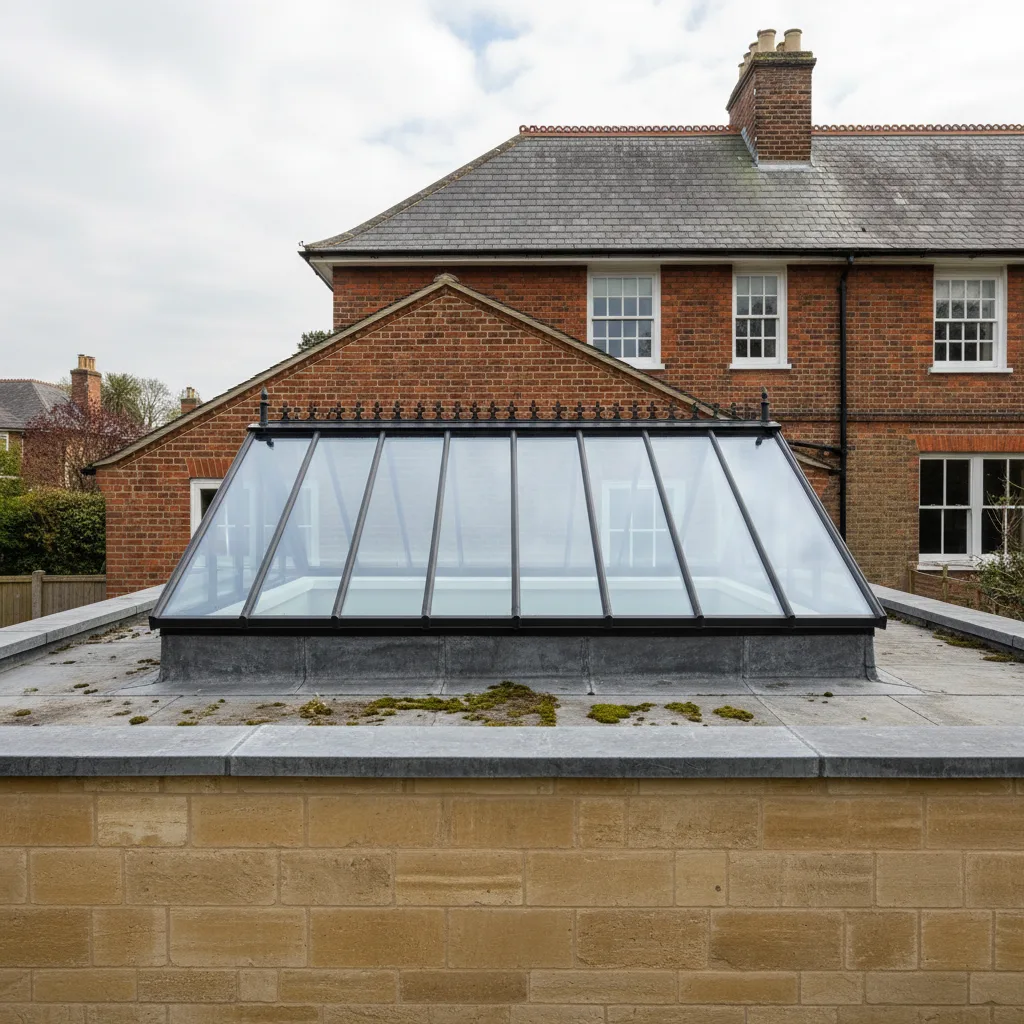
Good mesh fabrics are glass-fibre cored with a PVC coating, or solution-dyed acrylic, and both hold their appearance for a long time. What ages first is usually the mechanism: the side rail runners, the spring tension in the cassette, and the battery in a solar unit, which is typically good for several years before it needs changing.
Cleaning is occasional and low effort, being a matter of brushing the mesh and clearing debris from the cassette mouth. The awkward part is reach. An internal blind, by contrast, lives in clean still air, and its fabric will outlast the room’s decoration.
Set against each other, expect the external product to need attention within its life and the internal one not to. That is the trade for three times the thermal effect.
Access, and reaching a blind on a steep slope
Access decides more of this than performance does, and it is worth thinking about before ordering.
A rooflight in a loft bedroom on a 45-degree slope may be within arm’s reach at its lower edge. The same window on a 25-degree slope in a large flat ceiling may be four metres from the floor, and everything about it, blind operation included, has to be remote or motorised.
For internal blinds above two and a half metres, motorised or pole-operated is the only version that gets used. For external blinds, the practical rule is that anything not remote-controlled will be left in whatever position it happened to be in.
Access also governs replacement. A battery or a motor at the head of a cassette on a roof at four metres is a scaffold or a tower job, and that cost belongs in the decision rather than in a later surprise.
Ordering at install against retrofitting later
The difference in cost and difficulty is large enough to change what people choose.
| Item | Ordered with the unit | Added later |
|---|---|---|
| External awning, channel provided | Fitted while access is already set up | Possible, needs access equipment again |
| External awning, no channel | Choose a different unit | Not achievable without compromising the weathering |
| Internal blackout blind in side channels | Fitted to the frame at the same visit | Straightforward, provided the frame takes the fixings |
| Mains-powered blind | Cable routed before the reveal is closed | Means opening the reveal and redecorating |
| Solar-powered blind | No wiring either way | No wiring either way |
| Solar control glass | Specified in the sealed unit | Means a new sealed unit |
The pattern is that anything needing a cable or a factory decision should be settled at order, and anything solar-powered or frame-fixed can wait if the budget is tight.
Flat-roof units, where external shading is harder
Almost everything above assumes a pitched roof window, because that is where the retail products are.
A flat-roof unit or a lantern has no slope for an awning to run down and no frame channel designed to carry one. External shading there means either a fixed structure above the glass, such as a brise soleil or a slatted frame on its own supports, or a purpose-made external roller system on a bespoke track, which is a specialist product at a specialist price.
Because of that, flat-roof units are the case where the glass specification carries more of the load. Solar control glazing with a g-value in the low 0.3s does the work that an external blind would have done on a pitched slope, and it is usually the sensible answer. The wider approach to overheating is set out on solar gain, overheating and shading.
Shading against solar control glass
They solve overlapping problems and the difference is control.

Solar control glass works all the time, including on the February afternoon when you would have welcomed the warmth, and it slightly reduces daylight all year. It requires no operation, has no moving parts, needs no access and lasts as long as the unit. Its cost is paid once, at order.
External shading is deployed when wanted and retracted when not, so the winter solar gain is still available. It costs more, has a motor and a battery, and needs access. Its advantage is that it is the only option that reduces glare as well as heat, which matters a great deal for a screen in a home office.
On a slope receiving heavy afternoon sun over an occupied room, the pairing that works best is a moderate solar control glass and an external blind, rather than the most aggressive glass available with nothing else. The most aggressive glass darkens the room permanently to solve a problem that exists for three months.
What we fit, and what we do not
We install rooflights and we fit manufacturer blinds and awnings to those rooflights, internal or external, as part of the installation while the access is already in place. That is the point at which it is cheapest and cleanest for you.
We will fit a manufacturer’s external awning to an existing rooflight of ours or anybody else’s where the frame has the proper channel for it. We will not fix shading into a roof covering, a flashing or an upstand, and we will not build a freestanding shading structure, which is a different trade. Where that is what a job needs, we will say so and tell you what to ask for.
Tell us the slope orientation, the pitch, the room use and the height to the glass, and we can say which of these belongs on your roof. Call 01865 704245 or email info@heritageskylightsoxford.co.uk, and you will get a range by email first and a fixed price after a survey.
Four steps, no surprises
Survey
We look at the roof, the covering and the slope before we say anything about price.
Specification
The right unit and glazing for that roof and that orientation, in plain terms.
Fixed quote
Written, itemised and firm. The number does not move once work starts.
Install
Opening formed, unit set and weathered, covering made good. Notification is ours.
Helpful reading on this
Costs, comparisons and the questions we are asked most.
Tell us about your roof
We start with the building, the covering and the slope. Then we tell you what will suit it, and what it will cost, as a fixed written number.
- Surveyed before it is priced
- 10-year workmanship guarantee
- Building Control notification handled
- New installations and replacements