
Benson has an aerodrome on its doorstep, and what comes off it is not the steady high-altitude drone of an airliner. It is rotary aircraft, low, and what they produce is not sound alone but movement: a low-frequency pulsing that you feel through a building as much as hear. Glass in a roof is the part of a house that responds to that most, and specifying for it is a slightly different job from specifying for noise. This page covers both, along with the ordinary business of getting a rooflight into a Thames-side village.
Sound you hear, and sound you feel
Ordinary acoustic specification deals with mid and high frequencies: traffic, voices, rain on glass. Thicker glass and asymmetric panes work well against those, because they disrupt the frequencies at which a sealed unit naturally resonates.
Rotary aircraft produce a large share of their energy much lower down the spectrum. Low-frequency energy travels further, passes through the fabric of a building more readily, and is felt as pressure and vibration rather than heard as a tone. It is the reason a helicopter is noticeable indoors with the windows shut in a way that a car is not.
Glazing is comparatively poor at stopping low frequencies. This is worth saying plainly rather than selling an upgrade that will not deliver what somebody expects. A good acoustic specification in a Benson roof will meaningfully reduce what you hear. It will not eliminate what you feel when something passes low overhead, and no rooflight on the market will.
What is worth specifying anyway
Three things, and they cost little at order and cannot be added afterwards.
Asymmetric glazing, meaning panes of different thickness in the same unit. Two identical panes resonate together at the same frequency; two different ones do not, and the difference in measured reduction is real for the money.
Laminated glass, where the interlayer between the two plies damps vibration in the pane itself. It is the single most effective glazing choice against sound, and it is worth having on the inner pane of overhead glazing anyway on safety grounds, so it is frequently free in effect.
A wider cavity where the frame allows it. Acoustic performance improves with cavity width in a way thermal performance does not, and the two optimum widths are not the same. Where both matter, the compromise should be a deliberate decision rather than whatever the standard unit happens to be.
Beyond the glass, the install matters more than people expect. The perimeter between the frame and the structure has to be sealed and packed properly rather than left as a gap stuffed with offcuts, because sound takes the easiest path available and an unsealed junction is a considerably easier path than any pane of glass.
Vibration, fixings and the long game
The part nobody discusses, and the reason this page exists.
A building that is regularly exercised by low-frequency energy is subject to a great many more small movements over its life than one that is not. It does not damage anything quickly. What it does is find whatever was not fixed properly in the first place, and find it sooner.
The practical consequences for a rooflight are straightforward. Fixings need to be the manufacturer’s own brackets, into sound timber, at the specified centres, rather than approximated. A frame fixed at four points instead of eight will work perfectly for a while and then start to move. Lead that has been fixed along its length rather than at the head only will fatigue faster here than elsewhere, because it is being flexed more often. Sealant standing in for a detail will fail sooner.
None of this is special work. It is ordinary correct work, which matters more in a place that tests it. Where we are called to an installation that has loosened, it is very rarely because of the aircraft and almost always because the original fixing was optimistic.
Brick, flint and what the walls mean for the roof
Benson’s older stock is brick and flint, sometimes chequered, with clay tile roofs, and the newer housing around it is conventional twentieth-century construction.
What the flint means for a rooflight is not visible from inside. Flint and rubble walls are built as two faces with a rubble core, and they are strong in compression and weak in almost everything else. The wall plate that carries the roof sits on that construction, and the load path from a roof into a rubble wall is less predictable than into modern blockwork.
For an ordinary rooflight between rafters this is of no consequence, because the load goes into the trimmers and back into the rafters either side, and nothing new reaches the wall. It becomes relevant where a large opening is proposed and the structural design starts to change how load arrives at the wall plate. That is a survey question, and on an old flint building it is answered by looking rather than assuming.
Clay tile, and the detail it demands
Plain clay tile is laid double-lap, meaning every point on the roof is covered by two tiles, and the coursing is set out from the eaves upward.
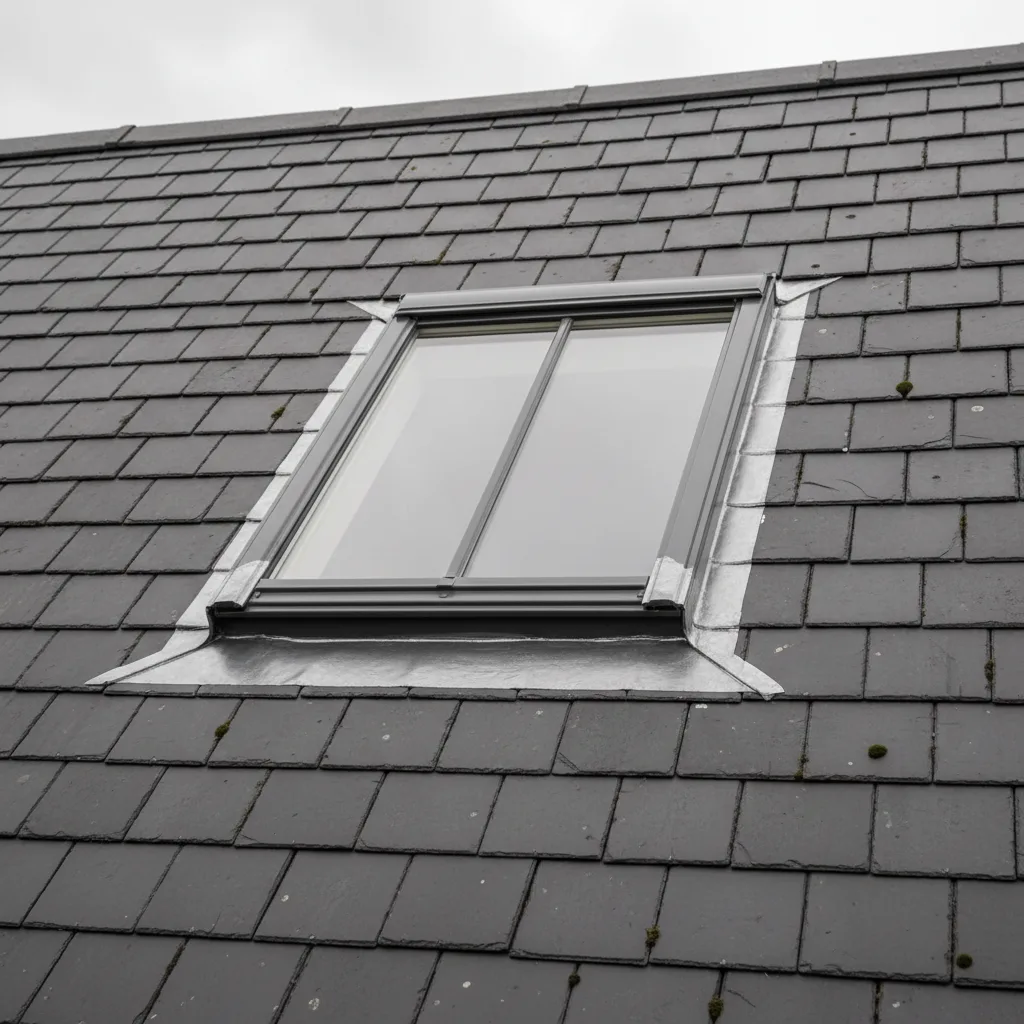
Cutting an opening into that means keeping the double lap true across the head and both sides of the unit, with the flashing sized for the tile rather than adapted from a slate kit. A slate-sized flashing forced onto a clay tile roof leaves the coursing running out of true, and a lap short somewhere it does not announce itself for several winters.
Old handmade clay tiles are also brittle and irreplaceable in the sense that a modern machine tile beside them looks wrong. Lifting them carefully, stacking them, and putting the sound ones back is part of the job rather than an optional courtesy.
The river, and the humidity that comes with it
Thames-side villages run at a higher ambient humidity than land away from the water, and mist sits on the meadows on still mornings well into the spring.
That raises the moisture load in the air generally, which means glass overhead reaches the dew point more readily and condensation appears earlier in the season than the same unit would produce elsewhere. It is not a defect and it does argue for two things at order: a warm-edge spacer without exception, since the edge of the glass is where condensation starts, and an opening unit rather than a fixed one wherever the room allows, because purging the air is the most effective response available.
Where a property is close enough to the river to have any history of flooding, that is worth mentioning, not because it affects the roof but because a house that has been wet at ground level runs at a higher humidity throughout for a long time afterwards.
Permission here
Benson falls under South Oxfordshire District Council. There is a conservation area covering the older core, and a number of listed buildings within it.
On a listed building, consent is engaged for a rooflight anywhere, including a rear slope out of public view, because listing covers the whole building rather than the visible parts of it. In the conservation area, a slope facing a highway will usually need permission and a concealed rear slope often will not.
On the later housing away from the core, most rear-slope work is permitted development, subject to the usual limits on projecting no more than 150mm beyond the plane of the roof and not sitting above the highest part of it. It remains notifiable under Building Regulations.
The aerodrome does not create any additional consent requirement for a domestic rooflight. It is worth saying because people occasionally assume it does.
Rain noise, which is the complaint people actually get
Setting aircraft aside, the most common noise complaint about any new rooflight is rain, and it is loudest in exactly the room people care about most.
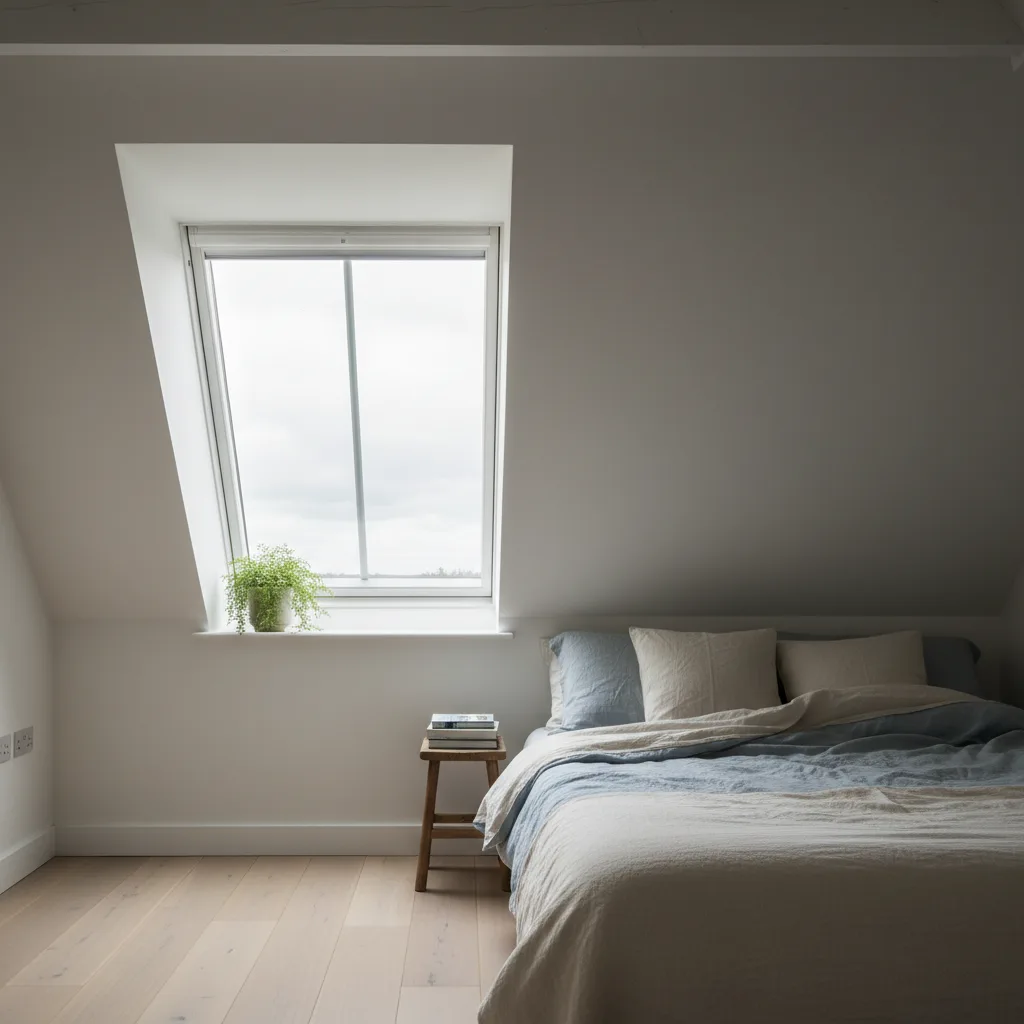
Rain on glass carries further into a room than people expect, and in a bedroom directly under a unit it is the thing that gets noticed. The remedies are the same as for any other sound: asymmetric panes, laminated glass, a properly sealed perimeter. All specified at order, none retrofittable.
It is worth deciding this deliberately rather than by default. Some people find rain on a rooflight one of the pleasures of having one. Others do not sleep through it. Nobody gets to change their mind afterwards without new glass.
Reading an acoustic figure without being misled
Glazing is sold with a single number, usually written as Rw and given in decibels, describing weighted sound reduction. Higher is better and the number is less useful than it looks.
The first caution is that it is a laboratory figure for the glass, measured in ideal conditions, and the installed performance of a whole rooflight in a real roof is always lower. The frame, the seals and the perimeter junction all reduce it.
The second is that the weighting behind the figure is skewed towards the frequencies of speech and traffic. Two units with the same headline number can perform quite differently against low-frequency sources, and the one that measures better in a laboratory may be the worse choice under a flight path.
The third is that decibels are logarithmic. A reduction of three decibels halves the sound energy but is only just perceptible; ten decibels is roughly what most people would describe as half as loud. So the difference between a standard unit and a modest acoustic upgrade is often more noticeable than the difference between that upgrade and a considerably more expensive one.
The useful question to ask a supplier is not what the number is, but what the spectrum adaptation terms are, which describe performance against low-frequency sources specifically. Any manufacturer publishes them and very few salespeople volunteer them.
The rest of the room
Worth saying because people spend a great deal on glass and are then disappointed.
Sound enters a room by every available path, and it is governed by the weakest one. A high-specification rooflight in a roof with uninsulated plasterboard around it, an unsealed loft hatch and a gap where a soil pipe passes through the ceiling will not deliver what the glazing figure suggests, because the glass was never the weak point.
In a converted loft the whole roof build-up is the acoustic element, and mass is what works: a denser insulation, an additional layer of board, and every service penetration sealed. None of it is expensive at the time and all of it is disruptive later.
So the honest sequence is to treat the roof build-up and the perimeter properly first, and then choose the glass. Doing it the other way round is the commonest way to spend money on a result that does not arrive.
What we take on locally
New rooflights and replacements of failed units, across the older brick and flint stock, the later housing and the converted outbuildings around the village. Acoustic specifications where they will genuinely help, and an honest account of where they will not.
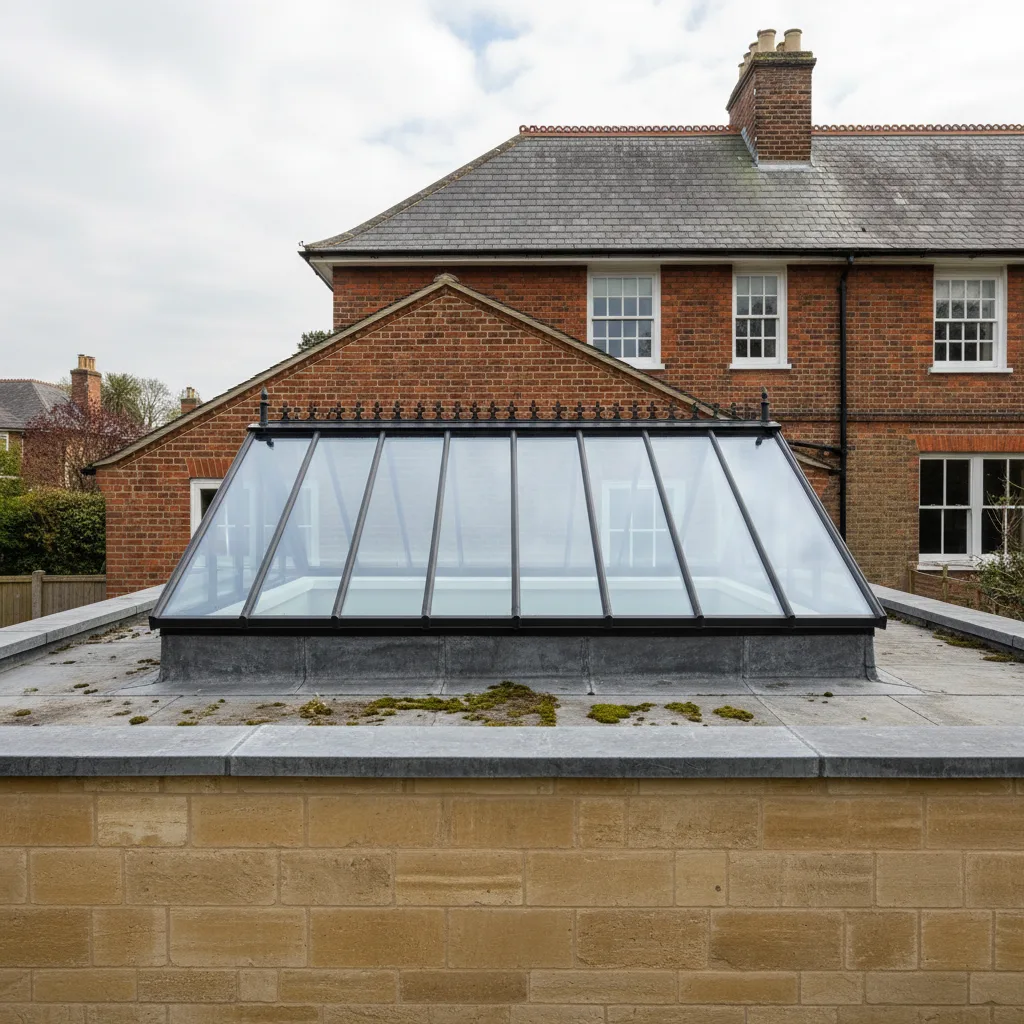
What we do not do is remedial roofing or re-covering. Where an old clay tile roof has become brittle enough that lifting it would do more harm than the rooflight does good, we will say so and decline the work.
Getting a useful answer back
Where in the village the house is, what the roof is covered with, which room you are lighting, and whether the building is listed or in the conservation area. If noise is part of why you are asking, say what specifically bothers you and at what time of day, because the answer for aircraft, for rain and for road traffic is not the same specification.
Benson is a straightforward run from Oxford and well within the twenty-five miles of road we cover.
Four steps, no surprises
Survey
We look at the roof, the covering and the slope before we say anything about price.
Specification
The right unit and glazing for that roof and that orientation, in plain terms.
Fixed quote
Written, itemised and firm. The number does not move once work starts.
Install
Opening formed, unit set and weathered, covering made good. Notification is ours.
Helpful reading on this
Costs, comparisons and the questions we are asked most.
Tell us about your roof
We start with the building, the covering and the slope. Then we tell you what will suit it, and what it will cost, as a fixed written number.
- Surveyed before it is priced
- 10-year workmanship guarantee
- Building Control notification handled
- New installations and replacements