
Nobody can price a rooflight from a photograph of the room. What follows is the honest structure of the cost: what the unit is worth, what the work around it is worth, and which handful of variables actually move the number. Read it and you will be able to tell whether a quotation you have been given is cheap, fair, or missing something.
The unit is the small half
This surprises people, and it is the single most useful thing to understand before you start collecting quotations.
A rooflight is a catalogue item. A standard centre-pivot roof window from a mainstream manufacturer, in a common size with double glazing, sits in the low hundreds. Larger sizes, top-hung openings, electric operation and triple glazing move it up a band at a time. A made-to-measure flat-roof unit or a roof lantern over a kitchen extension costs multiples of that, because the frame is spanning further and carrying more glass.
Any installer in Oxfordshire can order the same unit at broadly the same trade price. So when two quotations for the same product differ by a serious margin, the difference is almost never the rooflight. It is in the work around it, or in what one of them has left out.
Where the money actually goes
The installation is the larger half of a typical domestic job, and it divides into work you will never see once it is finished.
Forming the opening comes first. If the unit fits between existing rafters, this is trimming: cutting the rafter run, installing trimmers above and below, and doubling where the span requires it. If it does not fit between rafters, the roof structure is being altered, and on a trussed roof that means a designed solution with calculations behind it. The step between those two situations is the largest single jump in any rooflight quotation.
Then the perimeter. The upstand or kerb is built, the covering is lifted and re-laid around it, soakers and flashings are worked into the courses, and the underlay is dressed into the opening. This is where the labour hours sit on a pitched roof, and the covering decides how many. Concrete interlocking tile takes a proprietary flashing kit and goes quickly. Welsh slate has to be lifted, cut and re-dressed by hand. Stone slate is laid in diminishing courses, is heavy, and every slate coming off has to go back in the right place.
Then the inside. A rooflight opening has a reveal, and how that reveal is finished changes the feel of the room more than the unit does. Splaying the reveal to throw light down into the space costs more than boxing it square, and is usually worth it. Plasterboard, skim, and the decoration afterwards all sit here, along with insulating and sealing the reveal properly so the new opening is not a cold bridge.
Then access. A single-storey rear extension may be reachable from a tower. A three-storey Victorian terrace on a street with no parking needs scaffolding, a licence, and somebody to erect and strike it. Scaffolding on a constrained Oxford street is a real line on a quotation and it has very little to do with the rooflight.
The variables that move a price most
| Variable | Effect on cost | Why |
|---|---|---|
| Fits between rafters, or does not | Large | Trimming between is routine; altering structure needs design, and on trusses it needs an engineer |
| Roof covering | Moderate to large | Interlocking tile takes a kit; slate and stone slate are hand-worked around the opening |
| Access | Moderate to large | Tower against scaffold, and whether a licence or a neighbour’s permission is needed |
| Cold roof against warm roof | Moderate | Introducing a vapour control layer and reworking insulation is a build-up problem, not a window problem |
| Reveal finish | Small to moderate | A splayed and plastered reveal is a day’s work and a decoration; a square box is not |
| Electric operation | Small to moderate | Needs a supply run to the unit and someone qualified to terminate it |
| Flat roof against pitched | Varies | A kerb has to be built and the membrane dressed up and over it |
| Listed or in a conservation area | Moderate | Conservation-grade unit, hand-worked flashings, and a consent process with a fee and a wait |
What Oxford adds to the bill
Three local factors turn up often enough to be worth naming.
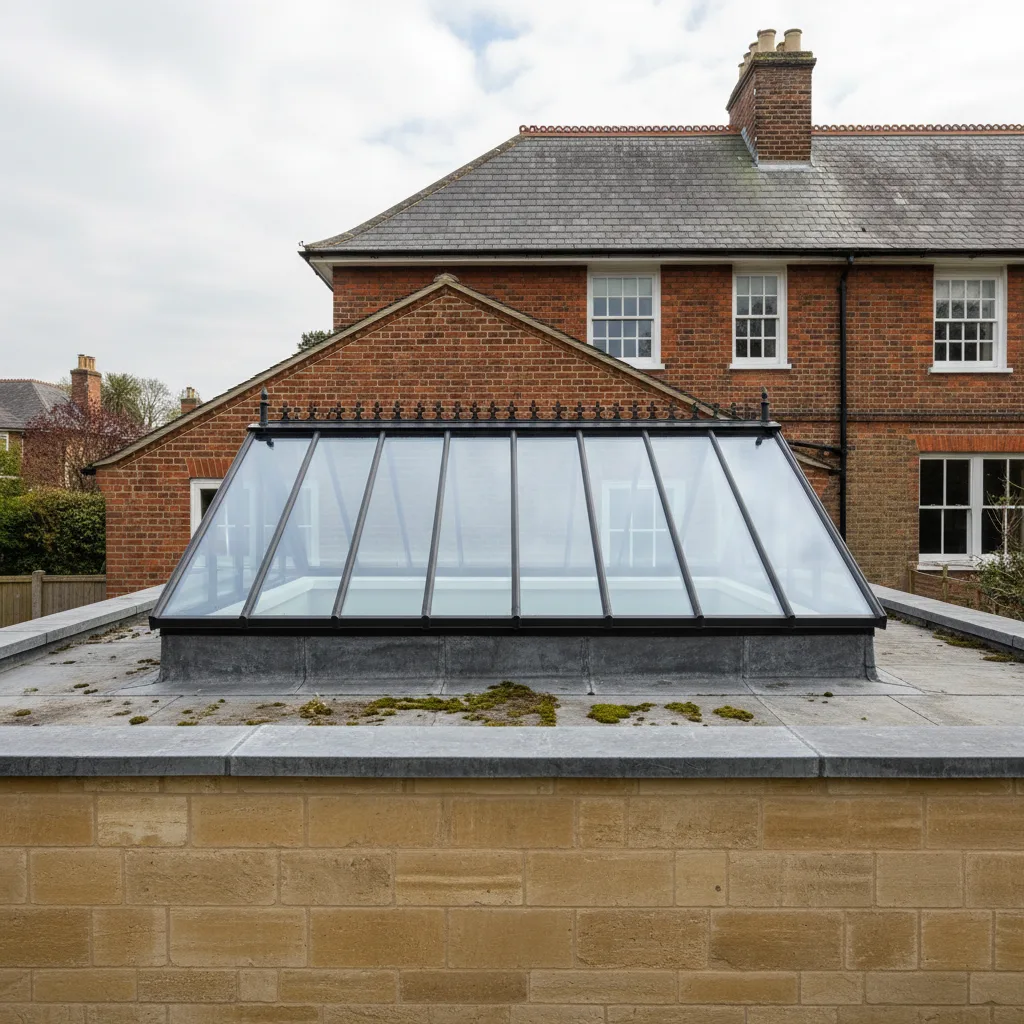
The first is designation. Oxford has a great many conservation areas, and the villages around it have more. A conservation-grade unit sitting flush in the plane of the roof, finished dark, costs meaningfully more than the equivalent standard product, and the flashings around it are hand-formed rather than clipped on. Add the application fee and several weeks of waiting before anybody can start.
The second is stone slate on the western side of the county, out towards Witney, Burford and Chipping Norton. It is beautiful, it is heavy, it is laid in diminishing courses, and working around an opening in it is a slow and skilled job. Nobody should quote it at the same rate as a concrete tile roof.
The third is access in the older streets. Jericho, parts of East Oxford and the town centres of Abingdon and Henley have terraces with no off-street parking, narrow frontages, and pavements that need a licence for a scaffold. It adds cost and it adds lead time, because the licence has its own queue.
Why we do not publish a fixed figure
Because a published price for this work is either padded to cover every case or it is going to change once somebody looks in your roof, and both are worse for you than a range.
What we will do is give you a realistic range by email, quickly, from four pieces of information: where the building is, what the roof is covered with, which room you are lighting, and whether the building is listed or in a conservation area. That range is honest about its own width. It becomes a fixed price after a survey, and the fixed price then does not move.
Three jobs, and why they price differently
Descriptions rather than figures, because the point is the shape of the difference.

A roof window onto a landing, 1970s estate house. Concrete interlocking tile, prefabricated trusses at regular centres, a standard unit that fits between two rafters without touching a web. The covering takes a profile-specific flashing kit. A tower reaches the slope from the side return. The reveal is boxed and skimmed. This is the cheapest kind of rooflight job there is, and it is usually in and finished within a day.
Two roof windows into a Victorian terrace loft conversion. Welsh slate, no underlay beneath it, shallow rafters, a stack on the party wall to work around, and no off-street parking. The slate is lifted and re-dressed by hand around each opening. Scaffolding is needed and the pavement needs a licence. The build-up has to be brought up to standard with a vapour control layer, because the loft is becoming a room rather than a store. Splayed reveals, because the whole point is light. Several times the first job, and most of the difference is labour and access rather than glass.
A lantern over a new kitchen extension. Flat roof, made-to-measure frame, a kerb built up above the deck and the membrane dressed over it. The unit itself is the expensive part here, which reverses the usual rule, and the frame spans far enough that its structural support is part of the extension design rather than an afterthought. Usually the largest of the three, and usually the one where the unit is more than half the cost.
Replacing a failed unit against forming a new opening
People assume a replacement is much cheaper, and often it is, but not always and not by as much as expected.
What you save is the structural work. The opening exists, the trimmers are in, and nobody is cutting rafters. On a like-for-like swap in a sound roof, that is a real saving and the job is short.
What you do not save is the perimeter, which is most of the skilled labour. The old flashings come out, the covering around the opening is lifted, and the new unit is bedded and flashed as carefully as a new opening would be. Access costs the same. Making good inside is often worse, because the old reveal has to come back to a clean line.
And the reason the old unit failed matters. If water has been getting past it for several winters, the timber around the opening may no longer be sound enough to carry a new frame. That is established when the old unit comes out, which is why a replacement quotation should say what happens if the opening is found to be in poor condition, and what that would cost. Ours does. A quotation that is silent on it has simply moved the risk onto you.
Reading a quotation properly
Ask any quotation the same questions, including ours.

Does it name the unit, by manufacturer and model, with the glazing specification and the U-value written out? A quotation that says “supply and fit rooflight” is not a specification, it is a hope.
Does it say how the opening is being formed, and does it say what happens if the structure needs altering?
Does it describe the perimeter detailing for your covering, or does it say “flashing kit” and leave it there?
Does it include making good inside, and to what standard? Plastered and ready to decorate is a different price from boarded and left.
Does it include access, and scaffolding if scaffolding is needed?
Does it say how long the roof is open?
Does it state the guarantee on the workmanship, separately from the manufacturer’s warranty on the unit?
If one quotation is materially cheaper and is silent on three of those, you are not comparing two prices for one job. You are comparing a complete description with an incomplete one, and the gap will be filled later at a moment when you have no leverage.
Where saving money is sensible, and where it is not
Sensible: fixed instead of opening, where the room does not need the ventilation. A standard size instead of a bespoke one, because bespoke frames carry a premium that a slightly smaller standard unit does not. Doing two units at once on the same roof, since the access is already up and the covering is already open. Decorating the reveal yourself.
Not sensible: skipping scaffolding where scaffolding is warranted. Accepting a generic flashing on a deep-profile tile. Leaving out the vapour control layer in a cold roof build-up, which saves very little and produces running water on the inside of the reveal by the second winter. Choosing an installer who will not still be trading in five years, because the workmanship guarantee is worth exactly as much as the firm behind it.
The cheapest rooflight installation available is always the one that gets fitted twice.
Four steps, no surprises
Survey
We look at the roof, the covering and the slope before we say anything about price.
Specification
The right unit and glazing for that roof and that orientation, in plain terms.
Fixed quote
Written, itemised and firm. The number does not move once work starts.
Install
Opening formed, unit set and weathered, covering made good. Notification is ours.
Helpful reading on this
Costs, comparisons and the questions we are asked most.
Tell us about your roof
We start with the building, the covering and the slope. Then we tell you what will suit it, and what it will cost, as a fixed written number.
- Surveyed before it is priced
- 10-year workmanship guarantee
- Building Control notification handled
- New installations and replacements